No deferral means the chatbot labeling requirement comes into force before anyone has a chance to check it.
An Incident That Changed Everything
Last Tuesday, marketing connected GPT-4 to a mailing campaign without a word to IT. The main domain's SPF was a hair's breadth from being burned. I blocked it in four hours.
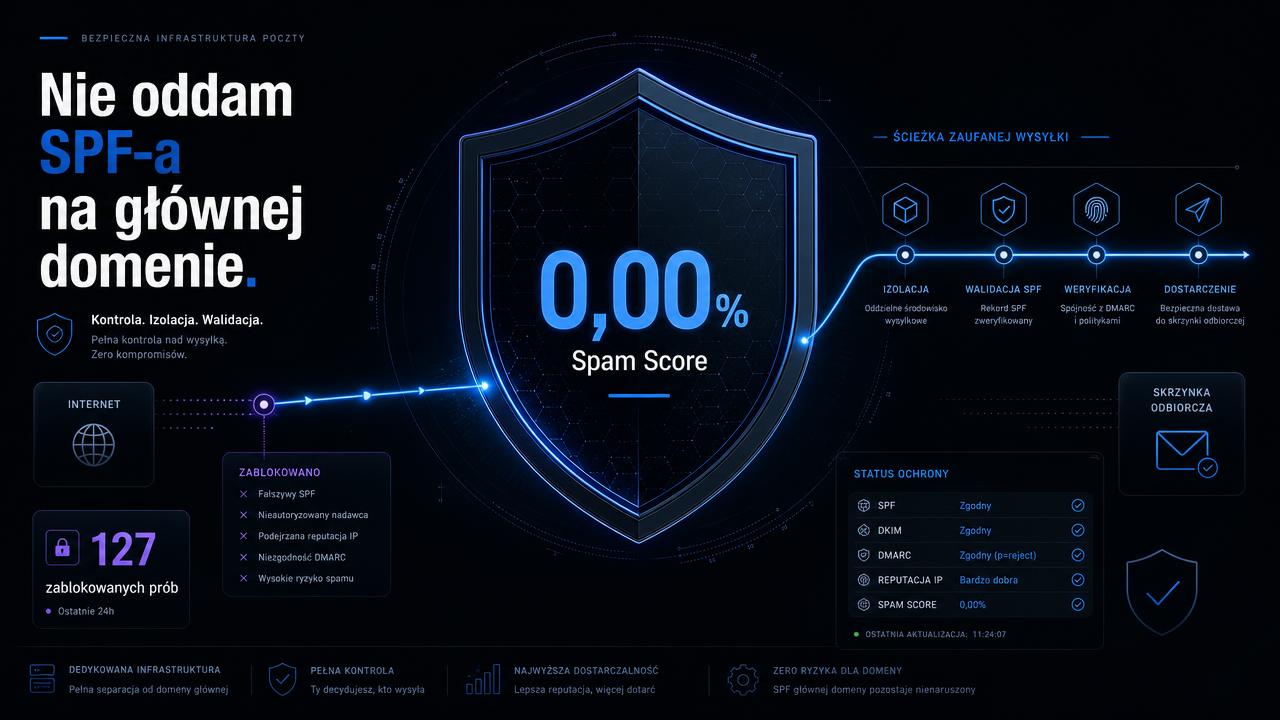
Since then, I've been measuring every incident. Last week, the telemetry of the isolated domain showed a 0.00% Spam Score and 127 blocked attempts to send a PESEL number (national ID) to an LLM.
Requirements of Art. 50 AI Act and Penalties
On August 2, 2026, Art. 50 of the AI Act became immediately effective. Every chatbot must inject an x-ai-generated: true flag into the API payload. An audit also requires a human-in-the-loop trace.
A violation is not a theory. €15 million from the AI Act. Up to €20 million from GDPR for a data leak. Shadow AI bypasses control. Autonomous agents sent from the main domain can burn its reputation for weeks.
Zero-Trust Architecture for AI
That's why I repeat one sentence. I will not give you the SPF for the main domain. This is not a CTO's whim. It's a rule of Zero-Trust DNS architecture.
Compliance is verified only through artifacts. A flag in the HTTP header. A separate domain with its own SPF, DKIM, and DMARC. Retention logs. A Labeling Rate of 100 percent. A drop below this value triggers an alert.
Our Solution: External Validation
I built an external validation layer. It works like a reverse-proxy. It anonymizes the prompt, receives the response, injects the Art. 50 label, and validates business rules.
The implementation took us five days:
- Day 1: Blocking queries.
- Days 2-3: Building the wrapper.
- Day 4: Domain isolation.
- Day 5: Human-in-the-loop implementation.
This is a system born from a mistake. Instead of patching business decisions after the fact, we moved all validation and telemetry outside the company. Zero IT team hours for integration. Full auditability.
Check if someone in your company has already verified how their tools label user interactions.
This article was created with AGAPE's proprietary content machine AGAPE Liberty.
Frequently asked questions
Ready to evaluate fit?
Book a 25-minute discovery call and let's see if AGAPE is the right partner for your next campaign.
Schedule a 25-minute discovery call