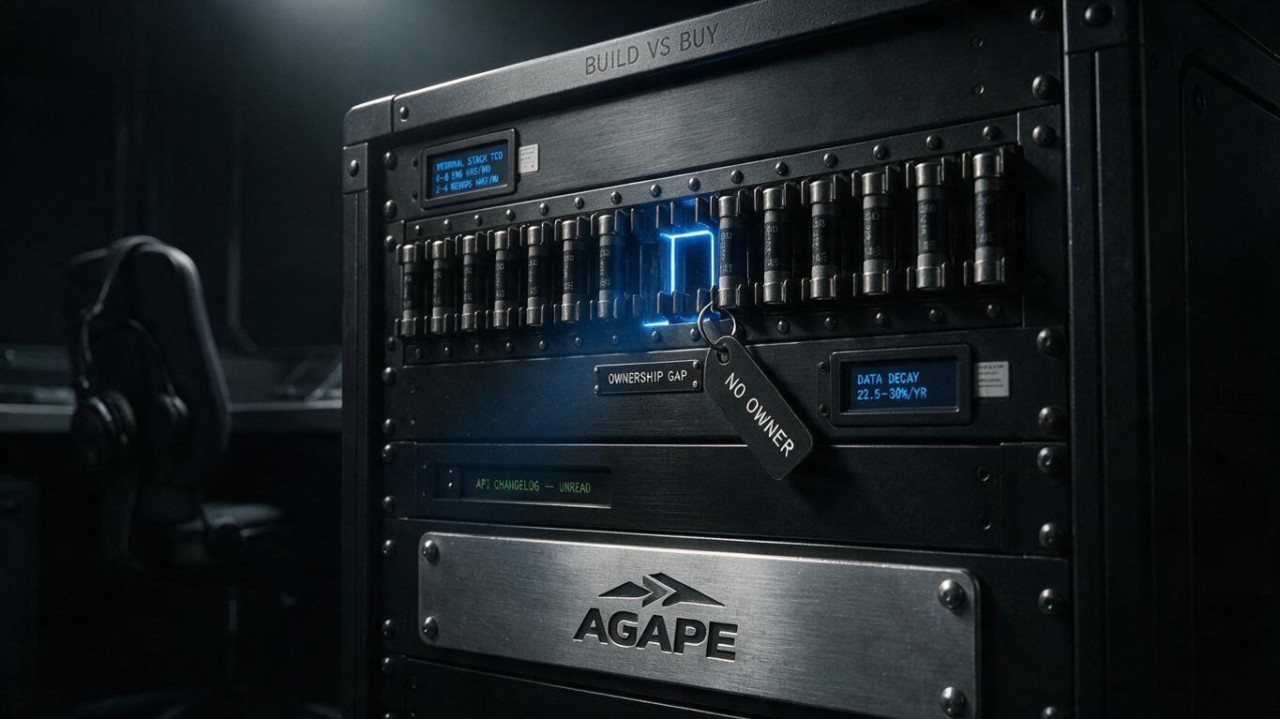
"Our internal sequencer worked fine until the one person who built it left."
That sentence comes up in boardrooms and revenue reviews the moment a campaign stalls or a key engineer departs. The real cost sits in untracked upkeep: maintenance hours, domain rotations, and compliance patches that were never logged, budgeted, or assigned a clear owner beyond the original builder. Once that person is gone, the costs that were always present become visible in missed quotas and emergency engineering tickets. COOs and VPs of Sales who treat outbound platforms as production infrastructure rather than side projects see the same pattern.
Outbound tooling is production infrastructure
Outbound sequencing platforms now sit at the core of B2B revenue engines, orchestrating email, dialer, and social touches across prospect lists pulled from CRM and data providers. A decade ago, these tools were add-ons; today they are embedded in daily SDR workflows and tightly integrated with systems of record. If the outbound platform fails, prospecting activity stalls and pipeline creation drops overnight. That makes the platform, whether internal or purchased, a piece of production infrastructure with obligations for reliability, observability, security, and regulatory compliance.
Internal sequencers arise organically when a capable engineer or technically inclined RevOps leader sees gaps in off-the-shelf tools or balks at enterprise pricing. The first version hooks into CRM, composes emails from templates, and pushes basic activity logs back. SDRs get tailored workflows, leadership avoids license spend, and the builder earns internal credibility. These tools are rarely chartered or staffed like products. They lack clear product ownership, long-term roadmaps, formal documentation, and on-call rotations. They are functional and fragile.
Maintaining an internal sequencer means carrying every obligation a vendor absorbs across its customer base. As long as the builder remains, the system appears cheap because almost none of the maintenance is budgeted or tracked. Fixes happen in slack time, evenings, or on unlogged tickets. When that person leaves or shifts roles, maintainers must first rediscover how the system works before they can safely change it. Outages stretch from hours to days, engineering hours balloon, and sales teams begin attributing missed quotas to tools that keep breaking. The ownership gap in sales tooling becomes the hidden line item behind the outage.
The maintenance bill that never appears on the purchase order
A rolling twelve-month view of an internal outbound tool reveals recurring work that vendors absorb across their customer base. The outbound stack maintenance cost becomes visible when every category receives an internal hourly rate and an annualized total. The calculations below use a fully loaded internal rate of $100/hour for engineering time and $60/hour for RevOps time. These are explicit planning assumptions, which makes the model easier to audit and adjust.
The modeled recurring total is $21,200–$37,760 per year before tooling subscriptions, unplanned incident response, and shadow work. Adding 40–60 engineering hours for initial SPF, DKIM, DMARC, and one-click unsubscribe setup brings the first-year total to $25,200–$43,760, which rounds to the $25,000–$44,000 baseline used in this article. The quantified recurring workload is 260–464 hours, or roughly 0.13–0.22 FTE based on a 2,080-hour work year. Including setup, the first-year load is 300–524 hours, or roughly 0.14–0.25 FTE. Incident response and undocumented recovery work sit above this baseline.
Deliverability monitoring and remediation
Deliverability is the most insidious maintenance category because its failures rarely show up as obvious errors. Emails still send, but open rates, replies, and pipeline erode as messages are throttled or land in spam. The 2024 Gmail and Yahoo bulk-sender rules crystallized this risk for anyone sending more than 5,000 messages per day to personal email domains. Those rules require SPF and DKIM authentication, DMARC alignment, RFC 8058 one-click unsubscribe headers, unsubscribe processing within two days, complaint rates below 0.3 percent, and valid forward and reverse DNS mappings over encrypted connections.
Deliverability monitoring in house is a maintenance loop. Engineering teams monitor Google Postmaster Tools for Spam Rate, Domain Reputation, and IP Reputation, then react when those indicators drift into risky ranges. They audit SPF, DKIM, and DMARC whenever domains, sending subdomains, or third-party services change. They validate List-Unsubscribe headers and POST endpoints end to end. They check PTR records against A and AAAA records and confirm TLS transport. Degraded DNS or misconfigured authentication can lead mailbox providers to throttle or reject mail even when the internal tool appears functional.
A mid-market B2B team with an internal sequencer needs at least 6–8 engineering hours per month for deliverability monitoring and remediation, plus 2–4 RevOps hours to review complaint data, adjust segmenting, and respond to unsubscribes. Initial setup of SPF, DKIM, DMARC, and one-click unsubscribe typically consumes 40–60 engineering hours. Vendors amortize that engineering cost across many customers and expose dashboards; internal tools require the company to carry the burden alone.
Domain and inbox configuration, warmup, and rotation
Outbound platforms live and die by domain and inbox configuration. Teams decide which domains to send from, how many mailboxes to provision per domain, how to warm those mailboxes gradually, and when to retire saturated or damaged sending identities. Gmail and Yahoo reinforced the need for clean forward and reverse DNS mappings and TLS transport. Every sending IP requires a valid PTR record mapping to a hostname the sender controls, and that hostname must resolve back to the IP via A or AAAA records. Failure of those records marks mail as suspicious and lowers deliverability before content is assessed.
Internal tools that interface directly with SMTP or provider APIs must embed a DNS and inbox management lifecycle. Someone plans and executes mailbox warmup, monitors sending volumes per mailbox, rotates identities to avoid provider rate limits, and ensures new domains are authenticated and protected by DMARC policies as they come online. Because a mailbox provider treats a domain crossing 5,000 emails per day as a permanent bulk sender, teams design sending patterns to stay within tolerances while still reaching quota goals. The stated baseline of 8–12 hours per month equals approximately 0.05–0.07 FTE based on a 2,080-hour work year; heavier outbound programs may require more.
Domain and inbox configuration, warmup, and rotation consume 4–6 engineering hours and 4–6 RevOps hours monthly for a mid-market internal tool. If the internal tool implements its own warmup logic or automated mailbox rotation, the engineering load grows further for initial development and ongoing tuning as providers adjust heuristics. The annualized cost sits between $7,680 and $11,520 before incident response.
API and schema change rework
API and schema change rework appears whenever a CRM or data provider alters its endpoints. Each change forces engineers who understand the internal sequencer to rewrite connectors and retest every downstream workflow. This line is variable and unbudgeted because no one schedules a provider API change six months in advance. A single endpoint change can consume 20–40 engineering hours per major change, and a mid-market team typically absorbs 1–2 changes per year, producing $2,000–$8,000 in annualized engineering cost.
The 2024 Gmail and Yahoo bulk-sender requirements are the clearest dated example of a mailbox provider requirement change forcing rework. The new authentication, unsubscribe, and complaint-rate obligations forced internal sequencers to rewrite sending logic, DNS handling, and unsubscribe endpoints. Teams that had built custom SMTP flows had to implement RFC 8058 headers, validate POST endpoints, and adjust complaint-rate monitoring. The same pattern repeats with CRM schema changes, enrichment provider API updates, and compliance shifts.
Maintaining an internal sequencer means owning every connector, every retry path, and every downstream workflow that depends on a changed field. The original builder often holds the mental model for those dependencies. When that builder is unavailable, even a small schema change becomes a discovery project. The annualized cost is modest on paper and expensive in practice because the work arrives without warning.
Data decay, enrichment, and suppression
Even a flawlessly configured outbound engine falters when its underlying contact data is stale. B2B CRM data decays 22.5–30% annually, which means roughly 2–3% of a database goes stale every month. Email addresses alone churn at about 3.6% per month, which compounds to roughly 36% per year. Job titles change at 25–35% per year, and company affiliations change at 12–20% depending on seniority and industry. Phone numbers and address data decay more slowly, but tech and SaaS records move fast enough to punish quarterly cleanup cycles.
Data decay, enrichment, and suppression consume 4–8 RevOps hours per month for a mid-market internal outbound tool. That work includes running hygiene cycles, suppressing bounced and unsubscribed records, enriching missing fields, and re-segmenting lists as roles and companies change. The annualized RevOps cost is $2,880–$5,760 before enrichment tooling and data-provider subscriptions. Without dedicated hygiene cycles, reply rates erode long before anyone notices the root cause, and sales teams blame the sequencer for a data problem.
The hygiene obligation is permanent because the database is a living asset. A quarterly cleanup leaves two months of decay in the sending pool. A monthly cycle keeps bounce and complaint rates within tolerance, protects domain reputation, and preserves the reply-rate assumptions behind every campaign forecast. Data decay is the quiet maintenance category that turns a working internal tool into a declining channel.
Single-point-of-failure recovery
Single-point-of-failure sales tools sit outside the hourly ledger. When the only engineer who understands the sequencer goes on holiday or resigns, recovery stretches from hours into days or weeks while sales activity stalls. Engineering hours spike precisely as outbound performance falls. The ownership gap in sales tooling becomes a pipeline problem, and the maintenance costs that were never tracked arrive as emergency engineering tickets and missed quotas.
When a developer leaves, an internal tool becomes a discovery exercise before it becomes a repair exercise. The new maintainer must reconstruct how domains are authenticated, where mailboxes are rotated, which connectors touch which fields, and how unsubscribe endpoints process opt-outs. Fixes happen in slack time, evenings, and unlogged tickets when the original builder is present; those habits hide the true load until the builder is absent. A single resignation can convert a stable outbound channel into a multi-week outage.
Single-point-of-failure recovery is expressed in recovery-time days and weeks rather than dollars because the cost lands in stalled pipeline. A ten-seat SDR team that loses five selling days to an outbound outage loses the meetings those days would have produced. The recovery work then consumes the same engineering capacity that would otherwise build revenue features. That is the ownership gap in sales tooling: the cost is real, the owner is missing, and the budget line never existed.
When the purchase price comparison finally becomes honest
Published and third-party pricing benchmarks place enterprise sales-engagement platforms at roughly $100–$180 per user per month on annual contracts, while mid-market tools often run $29–$99 per user per month. For ten seats, those base rates imply approximately $12,000–$21,600 per year at the enterprise range and $3,480–$11,880 at the mid-market range, before add-ons. A specific mid-market example at $85 per user per month equals $10,200 per year; data and mailbox add-ons can lift it to roughly $12,000–$14,000. A Vendr purchasing benchmark reports a median annual enterprise contract value of about $30,720 across more than 700 deals, but that figure reflects varied seat counts and packages rather than a ten-seat calculation. A $55,000–$70,000 three-year total should therefore be treated as an illustrative ten-seat enterprise scenario that includes add-ons, annual escalators, and possible seat expansion—not as the result of multiplying the base seat price alone.
The outbound tooling TCO comparison becomes honest once every recurring maintenance category receives an internal hourly rate and is annualized. Treating the tool as infrastructure rather than a side project makes the true total cost of ownership visible. A ten-seat team faces a base annual license of approximately $3,480–$11,880 at the mid-market range or $12,000–$21,600 at the enterprise range, before add-ons. The internal alternative has a modeled recurring maintenance cost of $21,200–$37,760, rising to $25,200–$43,760 in year one when initial authentication and unsubscribe setup are included. Add-ons, implementation, customer-side data work, and incident costs should be shown separately rather than blended into one range.
The comparison shifts the build vs buy outbound decision from purchase price to the ownership gap that appears the week the original builder is unavailable. Vendors price per seat and absorb platform maintenance across their customer base, while the customer still owns data quality, sender reputation, workflow administration, and some domain operations. Internal tools concentrate the platform obligations on the people who understand the system. The comparison becomes honest when both columns state which costs are included and which remain customer-side.
The citable answer for build vs buy outbound
In this model, running outbound on internal tools requires 260–464 recurring maintenance hours per year, or roughly 0.13–0.22 FTE, before subscriptions, incidents, and shadow work. At the stated internal rates, that equals $21,200–$37,760 annually, shifting the build-versus-buy decision from purchase price to maintenance ownership and recovery risk.
The two conditions where building still wins
Building remains the rational choice under two narrow conditions. The first condition is a genuinely non-standard workflow that no vendor supports. The second condition is a seat count large enough that per-seat vendor pricing exceeds the cost of a properly staffed internal platform. Every other case puts the maintenance bill and ownership risk ahead of the apparent savings of an internal build.
Condition one: non-standard workflow no vendor supports
When building outbound tools wins on workflow, the requirement is specific and durable. A team may need a sequence of touches, data sources, or compliance steps that no vendor supports. That workflow must be core to revenue, stable enough to justify engineering ownership, and valuable enough to fund a product owner, documentation, and on-call coverage. A non-standard workflow without those commitments becomes a permanent prototype.
A vendor gap is a real reason to build, and a vendor gap plus no product ownership is a future outage. The build decision must include the staffing model, the maintenance budget, and the recovery plan before the first line of code. If the workflow is non-standard and the company will staff it like production infrastructure, building can win. If the workflow is non-standard and the company will treat it as a side project, the ownership gap will price the decision later.
Condition two: seat count economics
When building outbound tools wins on seat count, per-seat vendor pricing exceeds the cost of a properly staffed internal platform. A large seat count can make those fees exceed the fully loaded cost of an engineering and RevOps team dedicated to the platform. The math must include 260–464 recurring maintenance hours per year, $21,200–$37,760 in recurring annual cost, the first-year total of $25,200–$43,760, and recovery risk.
Seat count economics favor building only when the internal platform is properly staffed. A team that builds to avoid license fees and then understaffs maintenance has moved the cost from a predictable subscription to an unpredictable incident. The two conditions are narrow because most teams have standard outbound motions and cannot justify a dedicated platform team. For those teams, buying wins on cost and resilience.
The diagnostic to run before the next resignation
If your outbound tooling depends on one person, say what happens the week they go on holiday. Who monitors deliverability dashboards, who reads the API changelog, and who owns domain authentication and mailbox rotation? Teams that can answer those questions with named owners and budgeted hours have already made the infrastructure decision explicit. Teams that cannot answer those questions now have the line items in front of them.
The maintenance bill and the ownership gap are visible once every category receives hours, an internal rate, and an annualized cost. That visibility removes the dependency on one person staying. The diagnostic is simple: name the owner for deliverability, name the owner for API changes, and name the owner for domain configuration. If those names exist with budgeted hours, the build vs buy outbound decision is already explicit. If those names do not exist, the next resignation or failed campaign will price the decision for you.
This article was created with AGAPE's proprietary content machine AGAPE Liberty.
Frequently asked questions
Ready to evaluate fit?
Book a 25-minute discovery call and let's see if AGAPE is the right partner for your next campaign.
Schedule a 25-minute discovery call