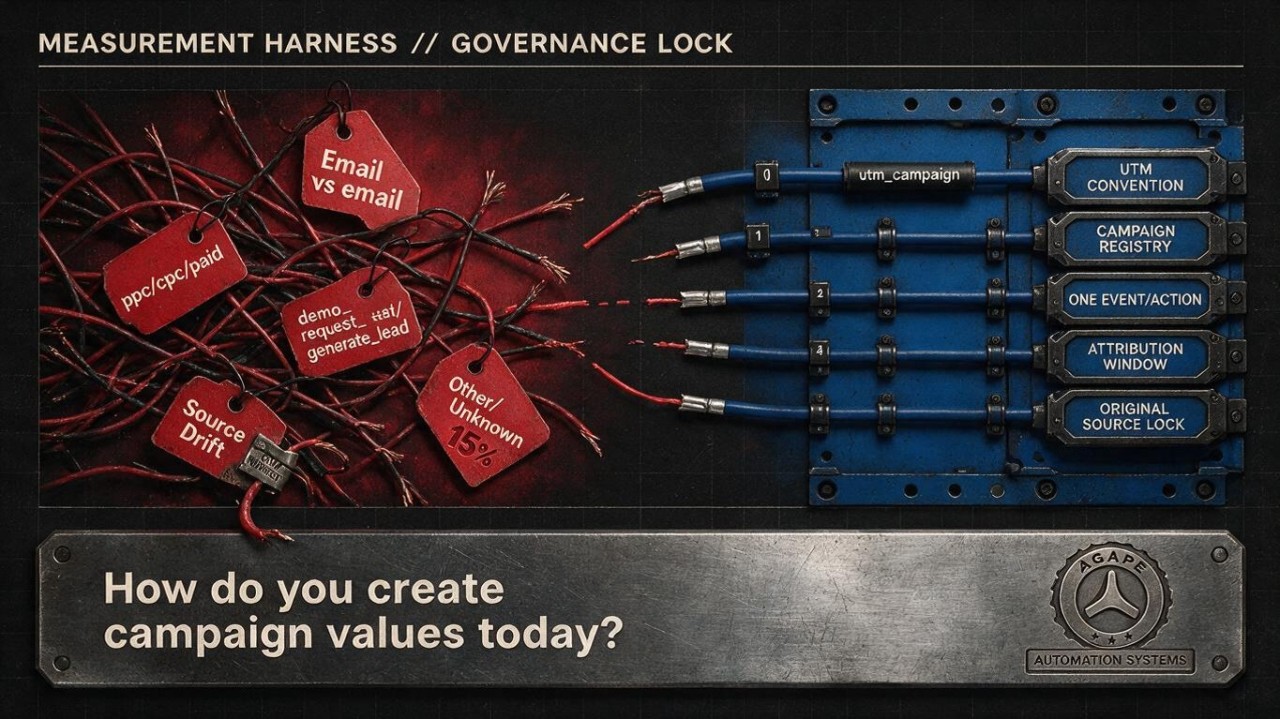
Every monthly report takes two days because the UTMs are a mess.
Three people wrote the campaign strings. One used capital letters. One used underscores. One guessed. The export now shows four rows for the same channel, two versions of the same goal, and a source column where the word «unknown» appears more often than any real channel name. The report goes to leadership on Thursday. On Friday, someone asks why paid search looks like the top channel in one view and a rounding error in another.
The two days are the visible cost. The invisible cost is the budget conversation that stalls because nobody agrees on which export is correct. Pipeline reports lose credibility before they reach the room.
Why one channel becomes four rows
Analytics platforms treat strings as distinct values. Email is not email. ppc is not cpc. paid is not paid_search. A team that tags campaigns by feel, campaign by campaign, produces a source column where a single motion fragments into four or five rows. The analyst then builds a manual mapping table each month - a spreadsheet that breaks when someone adds a new synonym.
This is a case discipline problem. It is also a vocabulary problem. Without a controlled list of approved source and medium values, every new campaign introduces a new alias. After twelve months, the medium column has forty distinct values where eight should exist.
Duplicate goals compound the fragmentation. A demo request fires demo_request on one page, generate_lead on another, and a generic button-click event on a third. All three carry key-event status. The monthly report now shows three conversion counts for one business action. The analyst picks one, guesses, or sums them and hopes nobody checks.
CRM source fields drift in the opposite direction. A rep overwrites the original acquisition value with the latest touch. The first-touch record disappears. Channel ROI becomes uncomputable because the history needed to compute it no longer exists.
There is a diagnostic threshold worth stating plainly: when more than 15 percent of deals show Other, Unknown, or blank in the Lead Source field, the organization has a structural process failure. That number is not a data-quality footnote. It is a signal that the source architecture was never designed.
Standard attribution windows make the situation worse. A 30-day or 90-day window structurally excludes the first two-thirds of a typical 6-to-18-month B2B sales cycle. Early-stage demand creation never appears in the numbers. The channel that created the pipeline looks like it did nothing, because the window never saw it.
What a clean B2B measurement setup requires
A clean B2B measurement setup requires five governed elements working together: a UTM naming convention with fixed parameters and case discipline, a single registry where campaign values exist before links are published, one goal event per business action with micro and macro conversions separated, an attribution window chosen and documented before reporting begins, and a CRM source field captured at discovery and locked at creation.
That passage is the standard. The rest of this article shows what each element looks like in practice and why the architecture has to move upstream of the monthly report.
The five governance pillars
Pillar one: a strict UTM naming convention
Every UTM value appears in lowercase. A single hyphen separates words. Source and medium draw from a controlled vocabulary that exists in writing before any link is built.
The campaign parameter follows a date-first pattern: year-quarter-program-tactic. This pattern sorts chronologically in every report and makes seasonal comparisons straightforward twelve months later.
A malformed string might read:
utm_source=Email&utm_medium=PPC&utm_campaign=SummerSale2026
The corrected version reads:
utm_source=email&utm_medium=cpc&utm_campaign=2026-q3-summer-sale-carousel
The corrected string tells the analyst the channel, the quarter, the program, and the creative variant - and it sorts correctly alongside every other string the team produced that quarter.
Three rules keep the convention intact. Lowercase everything, without exception. Use hyphens only, never underscores, because some URL parsers handle underscores inconsistently. Reserve utm_content for creative variants and utm_term for paid search keywords or defined audience segments, nothing else.
One additional rule is non-negotiable: never tag internal links. A UTM on a link between two pages of the same domain overwrites the visitor's original source. The attribution breaks silently.
Pillar two: a single registry with a named owner
Every campaign value is created and approved in the registry before any link goes live. The registry is a one-page list of approved utm_source and utm_medium values. It has a named owner, usually a senior analyst or paid media lead, responsible for approving new values and rejecting ad-hoc aliases.
The registry moves enforcement upstream: the person building the link selects from a picklist, so ad-hoc tagging at the point of creation disappears - and the repair work disappears with it.
A URL builder that reads from the registry makes the rule automatic. Anyone who builds a link either uses approved values or cannot build the link. The convention enforces itself.
Pillar three: one event per business action
One business action receives one event name in snake_case. A demo request form submission is request_demo_submit. The CTA click that opens the form is request_demo_click. These are two distinct events tracking two distinct actions.
Micro-conversions stay separate from macro-conversions. CTA clicks, pricing-page views, and content downloads are micro-conversions. Qualified demo requests are macro-conversions. Only macro-conversions receive key-event status.
This separation keeps conversion reports meaningful. When a CTA click carries the same status as a qualified demo request, the conversion count inflates and the report loses signal. When the two are separated, the analyst reads a funnel: clicks at the top, qualified requests at the bottom, and the conversion rate between them.
GA4's event model supports this structure. Event names are case-sensitive, must start with a letter, and may include letters, numbers, and underscores. Adopting snake_case as the team standard aligns with the platform's conventions and keeps reports consistent across people and time.
Counting rules matter too. A key event can count once per event or once per session. Choose the rule for each macro-conversion, document it, and apply it without exception.
Pillar four: an attribution window documented before reporting
The attribution window and model are chosen and documented before any report is generated. The window reflects the actual B2B sales cycle, not a platform default.
When a webinar happens 120 days before closed-won and the report looks back only 90 days, the model never sees the interaction. It cannot credit what it cannot see. This constraint is structural, not analytical. A more sophisticated model cannot recover touchpoints outside the lookback window.
The window decision belongs in the measurement documentation. It gets made once, published, and referenced in every report. Mid-report arguments about what counts disappear because the answer was written down before the argument started.
Hybrid attribution - multi-touch models for tactical optimization plus incrementality testing for validation - shows materially better cost outcomes than single-view ad-hoc models, but it requires governed data that a fragmented environment cannot provide.
Pillar five: CRM source architecture
Original Source is captured at discovery, locked at creation, and kept immutable. Latest Source records subsequent meaningful interactions without overwriting the first-touch record.
This two-field architecture answers two different questions. Original Source answers how the lead first entered the database. Latest Source answers what re-engaged the lead most recently. When one field tries to answer both, the first-touch history disappears the moment a rep logs a call.
The implementation rules are specific. Hidden source fields in forms should be filled on page load, not only on submit, because context can change during a long session. Source values must persist across pages via cookies or session storage, so UTM parameters present on the landing page survive navigation to a contact page that no longer carries them in the URL.
Source fields should always be populated, even with explicit values like direct or unknown. An empty field is ambiguous. It could mean missing data or an overwrite error. Neither is acceptable.
Original Source gets filled only if empty and stays forever; Latest Source updates on every new relevant interaction, within defined limits.
Strict picklists for source values prevent reps from inventing duplicate labels. UTM parameters captured at the point of conversion feed the source fields automatically. Manual entry introduces human bias and inconsistency.
What changes when the pillars operate together
Campaign values exist in the registry before publication. One event represents one action. The attribution window is known in advance. The Original Source field remains stable.
The monthly report assembles without manual repair. The analyst pulls the data, groups by the canonical channel names already in the registry, and reads the numbers. No mapping table. No goal deduplication. No argument about which export is correct.
Stakeholders stop debating whose figure is right - the figure is the figure. Budget decisions shift from disputes about data integrity to choices grounded in a single coherent view of how marketing creates pipeline. The two-day repair cycle is the first thing to go; the trust rebuild follows.
The decision that has to be made once
Every organization running B2B marketing reaches a point where the UTMs, goals, and attribution either get governed or keep producing fragmented reports. The choice is not which tool to buy. The choice is whether the conventions get written down, owned, and enforced at the point of creation.
How does your team create campaign values today, and who approves them before the links go live?
This article was created with AGAPE's proprietary content machine AGAPE Liberty.
Frequently asked questions
Ready to evaluate fit?
Book a 25-minute discovery call and let's see if AGAPE is the right partner for your next campaign.
Schedule a 25-minute discovery call