«Our outbound uses AI at three steps and nobody can tell me what we now have to disclose.»
That sentence has been sitting in my inbox since July, and the team that sent it runs a 40-person B2B software company in the Nordics. They use generative AI to draft cold emails, scoring tools to rank their list, and a classification model to route replies. Nobody on that team could name a single disclosure rule that applies to any of those steps.
Article 50 of the EU AI Act applies from 2 August 2026. The machine-readable marking duty for generative systems placed on the market before that date runs until 2 December 2026 under a limited grace period introduced by the AI Omnibus provisional agreement. Article 50 operates independently of any high-risk classification, which means even a low-risk system that drafts commercial email copy or runs a chatbot on a landing page triggers binding transparency duties. The obligations apply when AI systems reach people in the EU, regardless of where the outbound team sits. Non-compliance can result in administrative fines up to 15 million euros or 3% of total worldwide annual turnover for the preceding financial year, whichever is higher, with proportionality considerations for SMEs and small mid-cap companies.
The uncertainty on that team is not laziness. It is the rational response to four triggers that nobody has mapped to the actual workflow. Article 50(5) provides that mentioning AI in terms of service or a privacy policy does not satisfy the standard of clear, identifiable information at first interaction or exposure. The interpretive split on whether cold sales emails meet the published public-interest threshold in Article 50(4) means teams document the nature of the content and any human review applied. These are the exact reasons the question gets left alone.
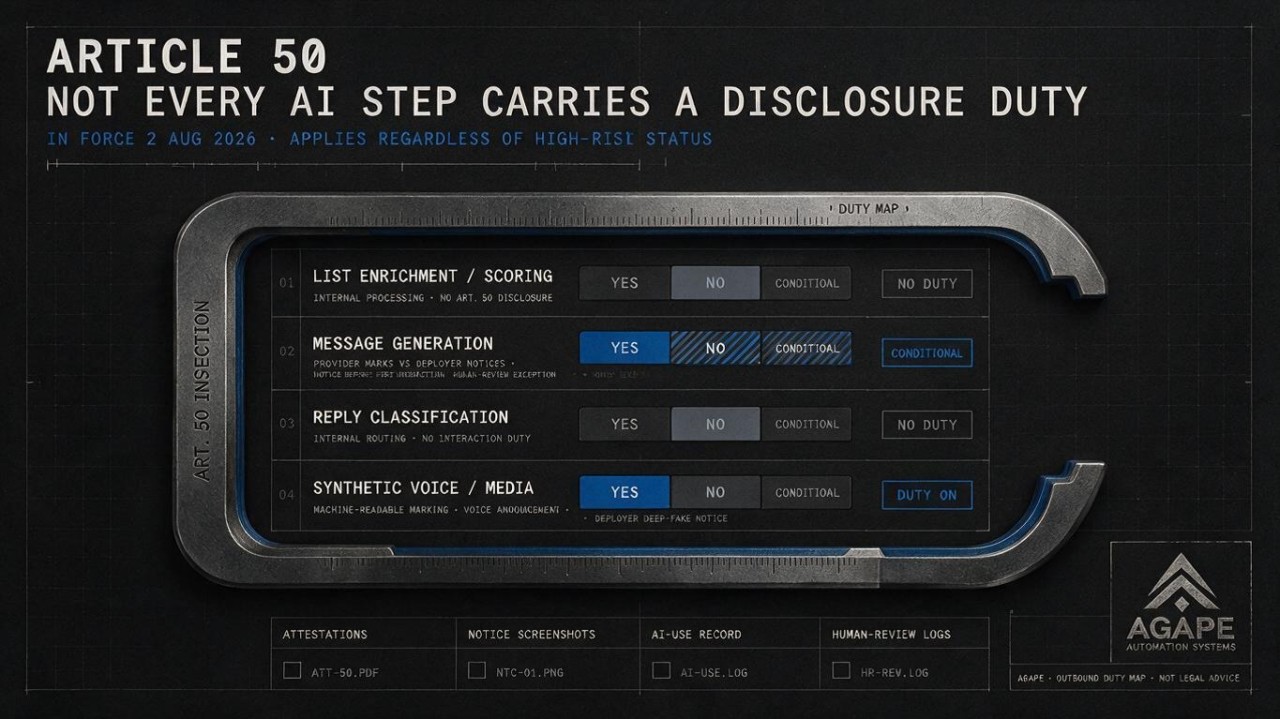
The step-level map below assigns each outbound step to a paragraph, a duty holder, a disclosure format, and a timing rule. That map is the relief.
What Article 50 requires of AI-assisted outbound communication
Article 50 requires AI systems that interact directly with people to disclose their AI nature, providers of generative systems to mark synthetic outputs as machine-readable, and deployers of emotion recognition or biometric categorisation to inform exposed persons. Deployers of deepfakes and unreviewed public-interest text must label it as generated. Disclosure must be clear and distinguishable at first interaction or exposure.
That passage answers the literal question your counsel or your client will ask in writing, and it traces to Article 50(1) through 50(5) and Commission guidance on transparency obligations for providers and deployers of certain AI systems. The rest of this article maps that answer to the steps where AI already sits inside outbound.
The regulatory framework and where Article 50 sits
The EU AI Act uses a risk-based architecture with four tiers: prohibited practices, high-risk systems, AI systems subject to limited transparency obligations under Article 50, and minimal-risk systems that face no mandatory requirements beyond general law. Prohibited practices under Article 5 ban manipulative systems, social scoring by public authorities, and indiscriminate biometric surveillance. High-risk systems under Article 6 and Annex III include credit scoring, employment screening, critical infrastructure management, and law enforcement applications, and carry extensive obligations on risk management, data governance, technical documentation, logging, transparency, human oversight, robustness, and cybersecurity.
Article 50 applies to AI systems whose defining risk is informational. Users might not know they are interacting with AI, or might not know that content they consume is AI-generated, and therefore might be misled or manipulated in subtle but socially significant ways. A cold outbound engine that uses AI to generate text will typically not be high-risk under Annex III, yet it can fall squarely within Article 50 if the AI-generated text is published to inform the public on matters of public interest or if the system directly interacts with natural persons. The outbound stack, often considered peripheral to core risk management, belongs in your AI inventory from the outset.
Article 50 consists of five paragraphs. Article 50(1) addresses AI systems intended to interact directly with natural persons. Article 50(2) covers AI systems that generate synthetic audio, image, video, or text content. Article 50(3) governs emotion recognition and biometric categorisation systems. Article 50(4) imposes disclosure duties for deployers of deepfakes and certain AI-generated text published on matters of public interest. Article 50(5) sets a general requirement that information be provided to natural persons in a clear and distinguishable manner, at the latest at the time of first interaction or exposure, and in conformity with applicable accessibility requirements.
These obligations apply to both providers, meaning entities that develop or place AI systems on the market, and deployers, meaning entities that professionally use AI systems, depending on which paragraph is engaged. That distinction is central to compliance planning.
The timeline and what changed
Article 50 applies from 2 August 2026. The AI Omnibus provisional agreement introduced a limited grace period for the machine-readable marking obligation in Article 50(2). Generative AI systems already placed on the market before 2 August 2026 have until 2 December 2026 to implement content marking and detection. Systems launched on or after 2 August 2026 must comply from day one.
Content generated prior to 2 August 2026 needs no retroactive labelling. Commission guidance encourages voluntary labelling of deepfakes created before that date where feasible, which builds trust with buyers who increasingly ask how AI sits inside your outbound process.
Non-compliance with Article 50 can result in administrative fines up to 15 million euros or 3% of total worldwide annual turnover for the preceding financial year, whichever is higher, with proportionality considerations for SMEs and small mid-cap companies. Transparency is not a cosmetic requirement, and reputational harm amplifies when buyers discover undisclosed AI use in communications that influenced their decisions.
The four triggers that attach Article 50 duties
The four triggers convert exposure into a concrete checklist.
Direct interaction with natural persons under Article 50(1). Generation of synthetic content under Article 50(2). Emotion recognition or biometric categorisation under Article 50(3). Creation of deepfakes or certain public-interest text under Article 50(4).
Each trigger has a duty holder, a disclosure form, and a timing rule. The sections below map those triggers to the outbound workflow in sequence.
Article 50(1): direct interaction with natural persons
Article 50(1) imposes a transparency obligation on providers of AI systems intended to interact directly with natural persons, requiring that such systems be designed and developed in a way that ensures individuals are informed that they are interacting with an AI system, unless this is obvious to a reasonably well-informed, observant, and circumspect person in the relevant context. The obligation focuses on the system's intended purpose. If an AI system is built to interact with people through text chat, voice calls, avatars, or other modalities, it falls under Article 50(1), even if in practice interactions are relatively infrequent.
Examples include customer-facing chatbots, virtual assistants, voice-based automated callers, AI SDR agents that reply to inbound emails, and interactive avatars on websites. Each must signal its AI nature clearly at or before the first exchange. Commission guidelines and expert checklists suggest practical implementations: explicit notices before the first interaction, persistent visual indicators during sessions, voice announcements at the start of automated calls, and clear signals when control shifts from the AI system to a human agent.
A mere mention in terms of use or privacy policies does not suffice. Article 50(5) demands that information be clear, readily identifiable, and provided no later than first interaction.
There are limited exceptions. Article 50(1) does not apply when the AI system is authorised by law to detect, prevent, investigate, or prosecute criminal offences, provided the system is not publicly available for reporting crimes. This carve-out primarily concerns law enforcement and security tools and has no direct relevance for typical B2B outbound workflows, though it may matter when organisations use investigative tools in compliance or fraud-related contexts.
Another nuance arises in determining when the AI nature is obvious from the point of view of a reasonably informed person, which might be the case for a clearly branded chatbot with a robot icon and language indicating automation. Commission guidance emphasises that relying on obviousness is risky, and urges providers to implement explicit disclosures rather than assume that users will infer the AI nature.
For outbound teams, the main implication is that any interactive outbound touchpoint controlled by AI, such as AI-driven replies to prospect emails or website chat flows initiated from outbound campaigns, should be treated as within scope. Providers should design the system to display AI disclosures, while deployers ensure that such features remain active and clearly visible in the deployed context.
Article 50(2): synthetic content marking by providers
Article 50(2) addresses AI systems, including general-purpose AI systems, that generate synthetic audio, image, video, or text content, requiring providers to ensure that outputs are marked in a machine-readable format and detectable as artificially generated or manipulated. This obligation applies to providers regardless of whether the AI system is high-risk and regardless of the specific domain in which the content is used, reflecting the legislature's concern that undetectable synthetic content undermines the integrity of the information ecosystem.
The marking must be effective, reliable, robust, and interoperable, enabling third-party detection tools to identify AI-generated or manipulated content across platforms and transformations. Commission guidance and industry checklists point to current state-of-the-art techniques: provenance metadata aligned with C2PA or Content Credentials standards, imperceptible digital watermarks, cryptographic fingerprints logged in secure registries, and verification tools that allow external parties to confirm artificial origin. A visible, user-facing notice is a useful complement but does not substitute for machine-readable marking, because Article 50(2) explicitly targets detection by machines and automated systems.
There are two notable exceptions. The marking obligation does not apply to the extent that the AI system performs an assistive function for standard editing or does not substantially alter the input data or its meaning. This carve-out recognises that many tools offer light-touch editing, grammar correction, or formatting assistance, where the resulting content remains essentially authored by a human and does not warrant synthetic origin detection. The obligation also does not apply when AI systems are authorised by law to detect, prevent, investigate, or prosecute criminal offences, mirroring the law-enforcement exception in Article 50(1).
For outbound workflows, the machine-readable marking obligation falls on providers of generative AI systems, not on the outbound team deploying those systems to draft emails or LinkedIn messages. If a B2B company uses an external AI writing tool or a general-purpose model API, the company is a deployer, and Article 50(2) directs the marking duty to the vendor that built and markets the generative model. This does not mean outbound teams can ignore marking altogether. They must ensure that their chosen providers have implemented Article 50-compliant marking methods, preferably documented contractually, and be prepared to explain to regulators or clients how AI-generated content within their campaigns can be technically detected.
Some guidance tailored to email outbound suggests practical workarounds such as campaign-level logs of AI-generated outputs or custom headers like X-AI-Generated: true in emails, but these measures demonstrate responsible deployment rather than fulfil the provider's legal duty under Article 50(2).
Article 50(3): emotion recognition and biometric categorisation
Article 50(3) imposes transparency obligations on deployers of AI systems used for emotion recognition or biometric categorisation, requiring them to inform natural persons exposed to those systems of their operation and to ensure that any processing of personal data complies with applicable data protection law, notably the GDPR. Emotion recognition systems infer emotional states from biometric data such as facial expressions, voice tone, physiological signals, or other behavioural indicators. Biometric categorisation systems classify individuals into categories based on biometric features such as ethnicity, gender, or age.
Deployers must provide prior information to individuals, for example through signage at the place of use or explicit notices in digital interfaces, and must identify a valid legal basis for processing sensitive data, often requiring explicit consent under Article 9 GDPR. In many cases, the use of such systems also necessitates a Data Protection Impact Assessment and, where relevant, a fundamental rights impact assessment under Article 27 of the AI Act, especially when the deployment may affect vulnerable populations.
In typical B2B outbound workflows, Article 50(3) is less directly engaged than the other transparency triggers but can become relevant in specific contexts. If an outbound team uses AI tools to analyse video calls with prospects for real-time emotion recognition, feeding insights into subsequent messaging or negotiation strategies, those exposed individuals must be informed that emotion recognition is being used and the processing must be grounded in a defensible data protection framework. Biometric categorisation might be implicated if an organisation deploys AI to classify leads based on facial characteristics or other biometric data obtained from social media or events, a scenario that raises substantial ethical and legal concerns beyond Article 50.
Given the sensitivity, most responsible outbound strategies currently avoid embedding emotion recognition or biometric categorisation directly into prospecting flows, preferring behavioural analytics and conventional engagement metrics that do not hinge on biometric inference. If your outbound stack includes any such system, the disclosure obligation runs to the exposed persons before processing begins, and the documentation set must include the notice text, the consent records, and the DPIA.
Article 50(4): deepfakes and public-interest text
Article 50(4) places transparency obligations on deployers of AI systems that generate or manipulate image, audio, or video content constituting a deepfake, as well as deployers of AI systems that generate or manipulate text published to inform the public on matters of public interest without human review or editorial control. The AI Act defines a deepfake as AI-generated or manipulated image, audio, or video content that resembles existing persons, objects, places, entities, or events and would falsely appear to a person to be authentic or truthful.
Deployers who use AI systems to create or alter such deepfake content must disclose clearly and distinguishably that the content has been artificially generated or manipulated, typically by labelling the output accordingly and indicating its artificial origin. This disclosure must be provided at the latest upon first exposure of individuals to the content and should be preserved when the content is reshared on third-party platforms. There is a special regime for deepfake content that forms part of evidently artistic, creative, satirical, fictional, or analogous works: in such cases, disclosure requirements are reduced and must be implemented in a way that does not hamper the display or enjoyment of the work.
The second aspect of Article 50(4) concerns text publications on matters of public interest. Deployers of generative AI systems must clearly label AI-generated or manipulated text that is published with the purpose of informing the public on matters of public interest when that text did not undergo human review or editorial control. Commission FAQs specify that three criteria must be met for the obligation to apply: the text must be published, it must be informative to the public, and it must concern matters of public interest such as politics and democratic processes, public administration and services, administration of justice and law enforcement, fundamental rights, public security, public health, or environmental protection. If AI-generated text on such topics is subject to meaningful human editorial review and a human editor or editorial entity takes ultimate responsibility for the content, disclosure is not required under Article 50(4), though other transparency or media ethics considerations may still apply. These rules take effect from 2 August 2026, without the extended marking deadline that applies to providers under Article 50(2).
In outbound contexts, deepfakes might arise in marketing or sales collateral, for example AI-generated videos depicting executives or customers endorsing products, synthetic product imagery that closely resembles real photos, or manipulated background scenes that present fictional events as authentic. When such content realistically depicts existing persons or events in a way that would falsely appear authentic, outbound teams qualify as deployers of deepfakes and must label the content as artificial.
More subtle is the application to AI-generated text on matters of public interest. Law firm analyses and specialised guides note that certain advertising, public relations, and corporate communications may qualify as public-interest text when they address topics like regulatory compliance, public health guidance, environmental claims, or governance issues, especially when disseminated as blog posts or press releases. Commercial sales emails usually do not meet the published and informing-the-public criteria, nor do they typically fall under the enumerated areas of public interest, leading some commentators to conclude that Article 50(4) does not require AI-generated marketing emails to be labelled. Others adopt a more expansive reading, arguing that any AI-generated content intended to inform or persuade recipients should be labelled, regardless of whether it is strictly public-interest text in the sense of the AI Act, as a matter of risk management and transparency best practice.
The conservative position for outbound teams is to document the nature of the content and any human review applied. Where a human editor or editorial entity takes ultimate responsibility, disclosure under Article 50(4) is not required.
Article 50(5): timing, clarity, and accessibility
Article 50(5) sets a common standard for the timing and quality of transparency information across all four obligations, requiring that information be provided to natural persons in a clear and distinguishable manner at the latest at the time of the first interaction or exposure. Disclosures cannot be deferred to later stages of a communication or hidden deep within legal documentation.
The requirement also includes conformity with applicable accessibility requirements, which means the disclosure must be perceivable and understandable by people with disabilities. A voice announcement at the start of an automated call, a persistent visual indicator during a chat session, and a clear signal when control shifts to a human agent all satisfy the timing rule when they appear at or before first exposure.
For outbound teams, the practical mechanics are straightforward. A voice announcement at the start of automated calls. A persistent visual indicator during any AI-driven session. A clear signal when control shifts to a human agent. A label on synthetic media at the point of first exposure. Each of these is a documentable control.
Mapping the four triggers to outbound workflow steps
The workflow below runs in the order most outbound teams operate: list enrichment and scoring, message generation, reply classification, and synthetic voice or media. Each step gets a duty determination, a duty holder, a disclosure form, a timing rule, and the documentation to retain.
List enrichment and scoring
Guidance suggests that standard list enrichment and scoring tools typically perform assistive functions that do not substantially alter input data. Article 50(2) therefore excludes such tools from the marking obligation. No disclosure duty attaches at this stage under the current text, provided the AI performs only light editing or formatting assistance.
The exception does not cover scoring models that infer sensitive attributes or that make decisions about individuals without human review. If your scoring tool ranks leads based on behavioural signals, it likely stays within the assistive carve-out. If it infers emotion or biometric categorisation, Article 50(3) may attach, and the disclosure duty runs to the exposed persons before processing begins.
Documentation for this step includes a vendor attestation confirming the assistive function and a record of the scoring criteria. That record shows the tool does not substantially alter input data.
Message generation
When generative AI produces email copy, LinkedIn messages, or other text, the provider bears the Article 50(2) duty to ensure machine-readable marking. The deployer, usually the outbound team, must verify that the chosen vendor has implemented compliant marking methods, preferably through contractual attestation. Verification should include technical evidence alongside contractual assurances: provenance metadata aligned with C2PA or Content Credentials, imperceptible watermarks, or cryptographic fingerprints in secure registries.
If the company uses an external AI writing tool, the company is a deployer and the tool vendor is the provider. If the company uses a model API, the model vendor is the provider. If the company custom-builds a generative system, the company may be the provider and carries the marking duty directly.
The interpretive split on whether cold sales emails meet the published public-interest threshold in Article 50(4) means teams should document the nature of the content and any human review applied. Commercial sales emails usually fail the published and informing-the-public criteria, but some conservative readings label them anyway as risk management. Where a human editor takes ultimate responsibility, disclosure under Article 50(4) is not required.
Article 50(5) provides that disclosure in terms or privacy notices alone does not meet the standard of clear, identifiable information at first interaction. Any visible notice in the message itself must appear at or before the first exposure.
Documentation for this step includes vendor compliance attestations, technical marking evidence, and a content analysis record where the public-interest threshold is evaluated.
Reply classification
Reply classification systems that analyse incoming messages and route or draft responses may engage Article 50(1) if they interact directly with natural persons. Where the system operates without human review and the AI nature is not obvious, providers must design the system to inform recipients that they are interacting with AI. Deployers must ensure the disclosure remains active in the deployed environment.
Examples include AI SDR agents that reply to inbound emails, customer-facing chatbots, virtual assistants, voice-based automated callers, and interactive avatars. Commission guidance indicates that explicit disclosure is safer than relying on the obviousness exception, because the reasonably informed person standard is difficult to apply in practice.
Practical mechanics include an explicit notice before the first interaction, a persistent visual indicator during the session, and a clear signal when control shifts to a human agent. A mere mention in terms of use or privacy policies does not suffice.
Documentation for this step includes the disclosure notice text and screenshots showing the notice relative to the first interaction.
Synthetic voice or media
Synthetic voice calls, video assets, or manipulated imagery fall under Article 50(2) for providers and Article 50(4) for deployers when the content constitutes a deepfake. The deployer must label such content clearly and distinguishably at first exposure. Voice announcements at the start of automated calls and persistent visual indicators satisfy the timing requirement in Article 50(5).
The deepfake definition covers AI-generated or manipulated image, audio, or video content that resembles existing persons, objects, places, entities, or events and would falsely appear to a person to be authentic or truthful. Outbound examples include executive endorsement videos, synthetic product imagery, and manipulated background scenes. Where the content forms part of an evidently artistic, creative, satirical, or fictional work, disclosure requirements are reduced and must be implemented in a way that does not hamper the display or enjoyment of the work.
Human editorial review provides an exception under Article 50(4) for text, but the exception does not extend to deepfake media. Disclosure should persist when content is reshared on third-party platforms.
Documentation for this step includes label text, screenshots showing the label at first exposure, and controls for resharing.
Documentation an outbound team should produce on request
The documentation set below is the operational relief. Each item has an owner, an evidence type, and a retention logic.
AI system inventory by outbound step, with the paragraph that applies and the duty holder. Provider or deployer role assessment for each AI system in the stack. Vendor attestations confirming Article 50(2) marking for generative tools. Technical marking evidence: C2PA metadata, watermark verification, or registry fingerprints. Disclosure notice text and screenshots showing timing relative to first interaction or exposure. Human-review logs where the Article 50(4) exception is relied upon for public-interest text. Public-interest text analysis documenting the three criteria and the conclusion. Deepfake labelling and resharing controls, including label text and screenshots. Emotion recognition and biometric categorisation notices, consent records, DPIA and FRIA records where applicable. Accessibility checks confirming disclosures conform to applicable accessibility requirements. Pre-2 August 2026 content records showing generation date, with a note that no retroactive labelling is required. Campaign-level logs of AI-generated outputs and any custom headers used for internal traceability, with a note that these do not replace provider marking.
Pre-2 August 2026 content requires no retroactive labelling, so the documentation set should record the generation date and any voluntary deepfake labelling applied. That record shows the content predates the compliance date.
Which outbound step are you least sure about - list enrichment, message generation, reply classification, or synthetic media? Say it in the comments.
This article was created with AGAPE's proprietary content machine AGAPE Liberty.
Frequently asked questions
Ready to evaluate fit?
Book a 25-minute discovery call and let's see if AGAPE is the right partner for your next campaign.
Schedule a 25-minute discovery call