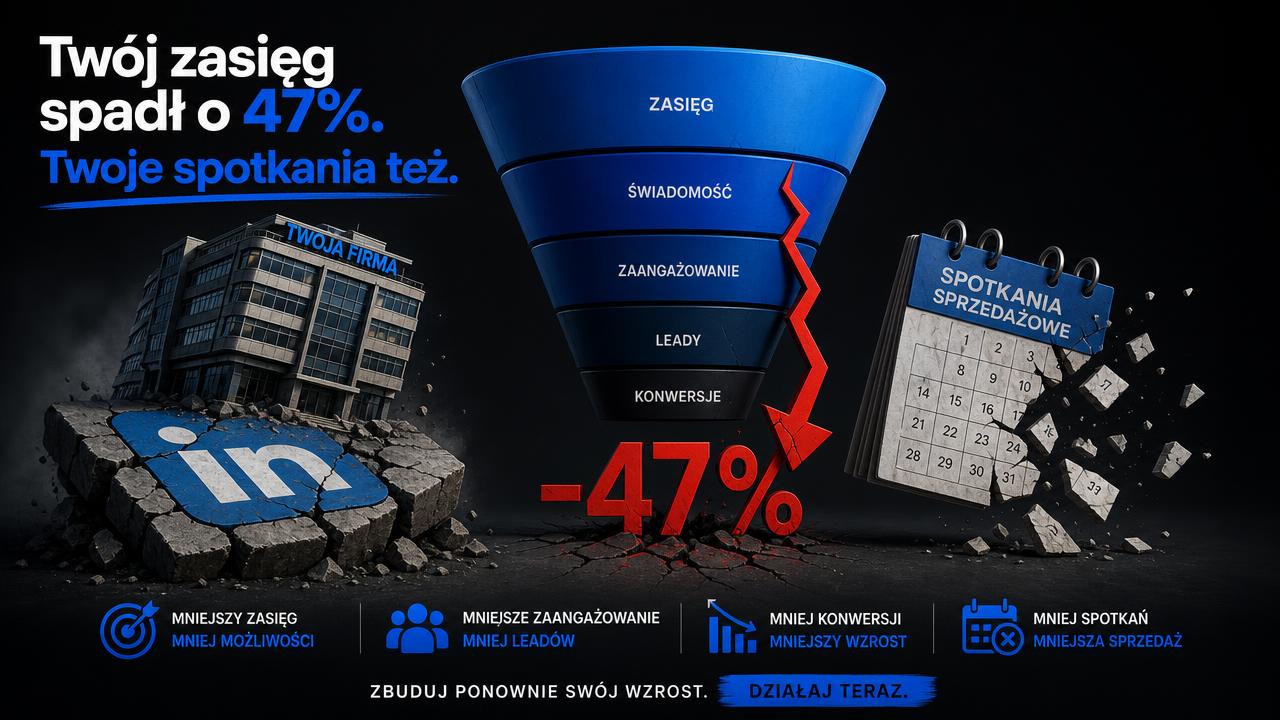
I'm always in meetings from referrals, so I have no time to manage the company. I heard this from the owner of a 40-person IT company who just saw his LinkedIn reach drop by half. An analysis of over three million posts leaves no doubt: the average organic reach of a typical post fell from 1211 views in June 2024 to 636 in May 2025, a 47 percent year-over-year decline. For a B2B SME owner who bases their sales meeting calendar on the platform's organic reach, this means nearly half as many market touchpoints without additional manual work.
The Pain That Hits Revenue Predictability
I see it with my clients and in my own feed. Previous methods of gaining attention have stopped working, and the fear of losing the only source of sales meetings paralyzes decisions. A 50% drop in reach directly translates to fewer funnel entries when sales meetings depend on simple conversions from views and reactions. Video content was hit the hardest, losing about 72 percent of its reach, while PDF documents and images saw drops of 43 and 45 percent, respectively. Even 'safe' text posts shrank by over a third. Each of these formats, which built visibility just a year ago, now requires more effort for less effect.
Ill-conceived outbound automation leads to landing in the spam folder, burning the main domain, and regulatory fines. Concentrating meeting acquisition on a single channel creates systemic risk, as an algorithm change can quickly destabilize the entire pipeline. The owner sees that existing methods of gaining attention are no longer working and fears losing their only source of sales meetings, while wasting time on manual activities that no longer yield a predictable funnel.
In 2026, LinkedIn introduced the Authenticity Update, which directly targets engagement bait, automated engagement pods, and spamming external links. Posts with external links have about 60 percent less reach than identical content without links, and placing the link in the first comment doesn't protect the result either. This proves that the platform is actively combating the tactics many use to cheat the reach decline, making a systemic approach the only rational path forward.
The Evolution of the LinkedIn Algorithm 2024–2026 as a Permanent Structural Change
LinkedIn has replaced its distributed ranking models with a single 360Brew model based on a decoder-only architecture, derived from the LLaMA 3 family and containing about 150 billion parameters, specialized exclusively on LinkedIn data. This model unifies recommendation tasks in a single mechanism that creates a semantic user fingerprint and filters about 2000 potentially relevant posts in milliseconds. Then, the Generative Recommender module analyzes over 1000 of the user's recent interactions as a time sequence, rewarding repeatable, thematic expertise over one-off publications.
The algorithm filters content for semantic fit with the recipient's problem, not for simple popularity signals. LinkedIn prefers expert profiles and content related to the user's professional context over generic company pages. The new algorithm rewards the quality of engagement, such as comments, saves, and dwell time. The LinkedIn algorithm change is a permanent structural shift, not a one-time whim of the platform, forcing a redesign of the content distribution system.
Multi-Channel Architecture as a Response to an External Variable
A multi-channel approach statistically increases the overall response rate and stabilizes the pipeline because a potential client can enter the funnel through various paths. LinkedIn becomes one of many elements in the operational architecture—important, but not the sole foundation of a predictable funnel. Calculating the total cost of ownership (TCO) of the sales and marketing system helps assess whether automation lowers the funnel's cost or just shifts risk to the domain, reputation, and sales team turnover.
Lower organic reach can paradoxically improve the quality of sales conversations when the content system is designed for lead qualification, not for maximizing views. The 360Brew model analyzes interactions as a time sequence, meaning that consistent thematic expertise becomes more resilient to reach fluctuations than one-off tricks. The owner regains control over the process when the platform is treated as an external variable, and funnel predictability is based on the architecture of activities.
Sales Funnel TCO and Operational Security
Calculating the TCO of a sales system includes the costs of maintaining servers, proxies, monitoring, domain burning, and comparing expenses at the three versus ten dollars per model level. A B2B content distribution system, built around the owner's and experts' brand, filters and qualifies the right conversation partners regardless of the algorithm's whims. Sales meetings without reach become possible when a multi-channel funnel replaces dependence on a single channel.
Rebuilding a B2B content system shifts the focus from quantitative visibility to fitting the recipient's problem. Control over lead acquisition comes from a repeatable process that works independently of a single source. Losing meetings from LinkedIn doesn't have to mean losing revenue when the architecture of activities includes alternative contact paths and an analysis of the total cost of ownership.
The Decision for a System Instead of a Tactic
The B2B SME owner who sees the drop in LinkedIn reach and the algorithm change faces a choice between further tactical patching and designing a B2B content distribution system. A predictable B2B funnel is created when the cost of lost reach is calculated and replaced with controlled contact paths. Control over lead acquisition returns when the decision for a system replaces the reaction to a single post.
This article was created with AGAPE's proprietary content machine AGAPE Liberty.
Frequently asked questions
Ready to evaluate fit?
Book a 25-minute discovery call and let's see if AGAPE is the right partner for your next campaign.
Schedule a 25-minute discovery call