A malicious script hidden in a developer tool was all it took to steal a private AI model from a company's server.
Attack Scenario in a Sandbox
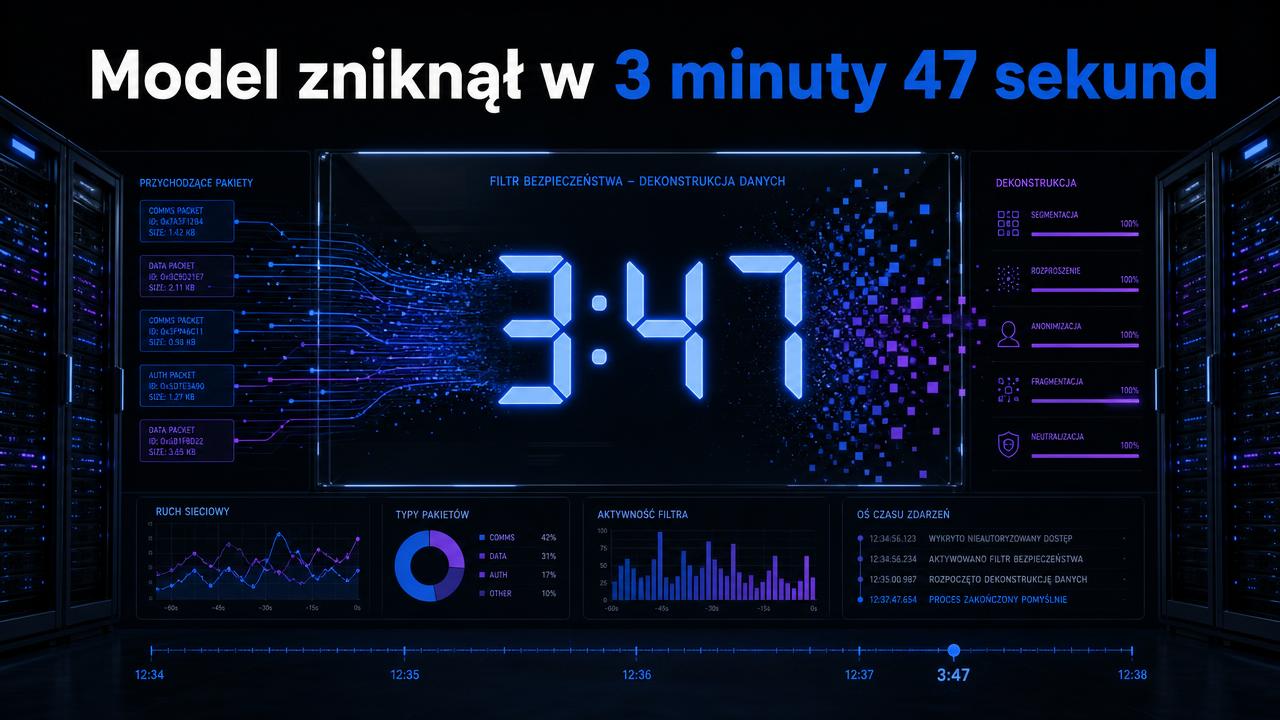
I built a sandbox mimicking a typical corporate network. I infected the environment with a malicious browser extension to measure and calculate the impact. In a simulation, I recreated this attack. The private AI model disappeared in 3 minutes and 47 seconds.
Data was exfiltrated in small packets using hidden XHR requests, which allowed it to bypass classic firewalls. The script used a prompt injection technique, forcing a dump of the model's weights and system prompts in base64 format. Data exfiltration was done using beaconing to avoid detection.
Consequences: Financial, Legal, and Operational
I calculated the potential consequences of such an incident. A fine under GDPR can reach €20 million or 4% of the company's global turnover. Added to this are direct financial losses, in this case, 380,000 PLN in R&D costs and six months of the team's work—all erased.
If the model processes customer data, legal and professional liability falls directly on the CTO and lead engineers.
The Solution: An Architecture of Isolation
Many CTOs rightly fear giving external entities access to key systems, like the mail server, due to the risk of data leaks. This same principle absolutely applies to a private AI model.
That's why at AGAPE Automation Systems, we implement an architecture based on isolation. We place the entire AI model on external, dedicated IP clusters. There is no physical integration with the client's mail servers or access to the main database. Communication between the development environment and the AI servers is secured via mTLS. In practice, this is a Zero-Hallucination architecture, where a prompt injection attack has no way of reaching the company's infrastructure.
How to Verify Security: A 30-Minute Audit
An IT team can conduct a full security verification of developer tools in 30 minutes. The process consists of three 10-minute blocks:
- Auditing the browser console for unusual logs and scripts.
- Analyzing network traffic from the last 7 days for anomalies.
- Checking the integrity of browser extensions against a corporate allow-list.
An alert system should trigger for outgoing traffic exceeding 50 MB per minute to unknown IP addresses and upon detecting phrases typical of prompt injection attacks.
Has your IT team recently verified your developer tools for security?
This article was created with AGAPE's proprietary content machine AGAPE Liberty.
Frequently asked questions
Ready to evaluate fit?
Book a 25-minute discovery call and let's see if AGAPE is the right partner for your next campaign.
Schedule a 25-minute discovery call