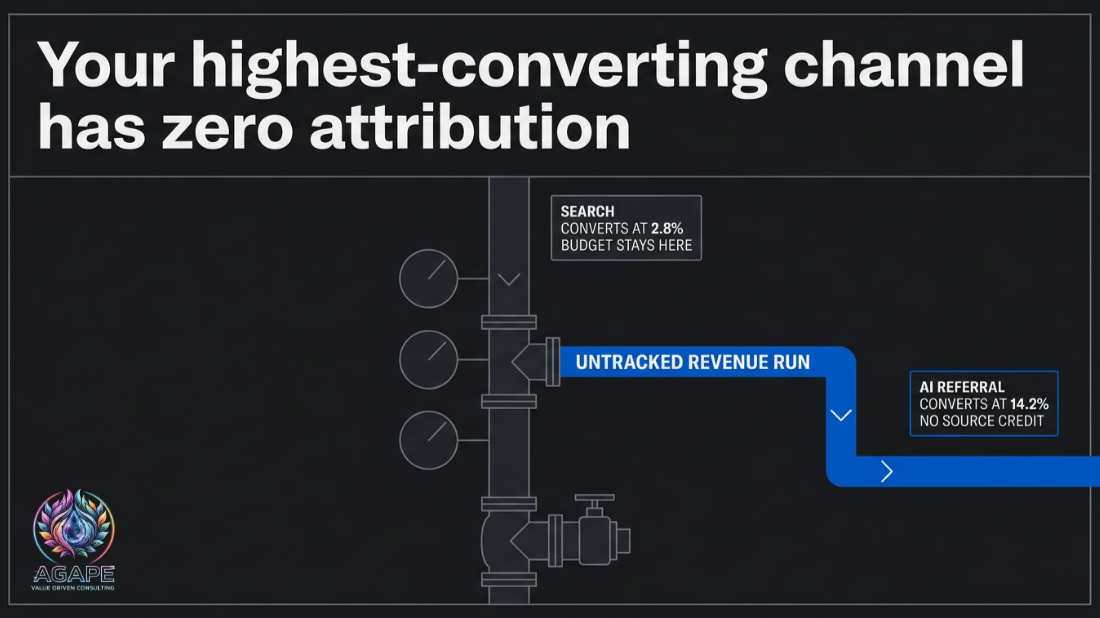
A 14.2% conversion rate from AI assistant referrals compared to a 2.8% baseline from Google organic demands an immediate audit of enterprise attribution models before shifting capital. CMOs and Heads of Growth require verifiable pipeline data inside existing analytics stacks before altering their marketing budget allocation - ensuring capital movements reflect closed-won revenue across the entire buyer journey.
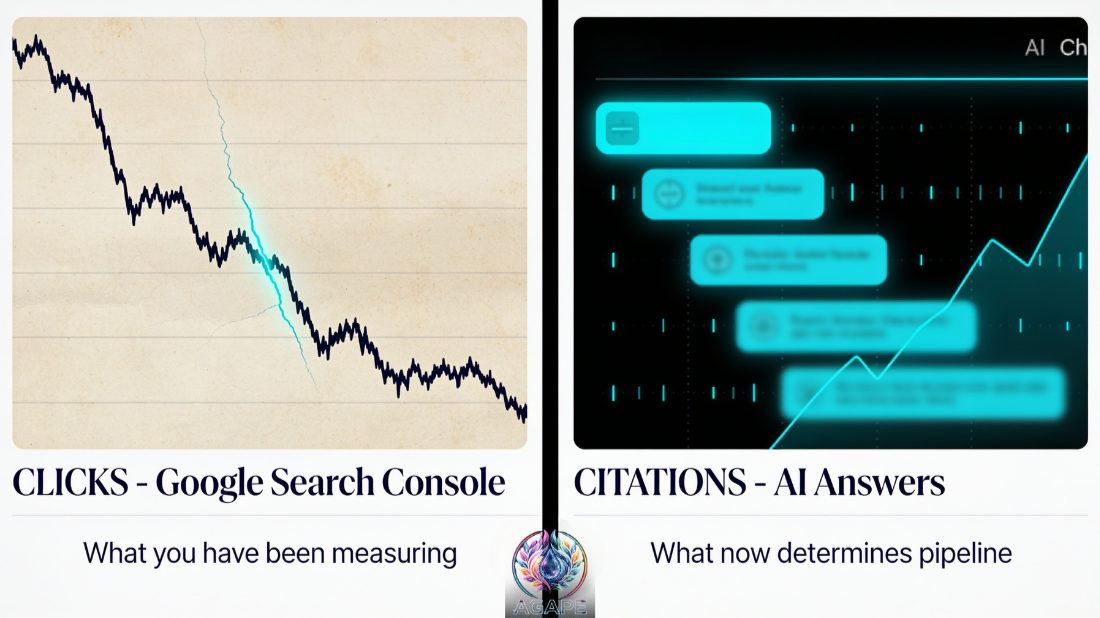
Traffic volume obscures true efficiency. Marketing leadership frequently protects legacy search spend based on top-of-funnel impression scale and visible cost-per-click metrics, while high intent traffic arriving through conversational interfaces remains unclassified inside undifferentiated referral buckets.
The attribution breakdown behind search volume
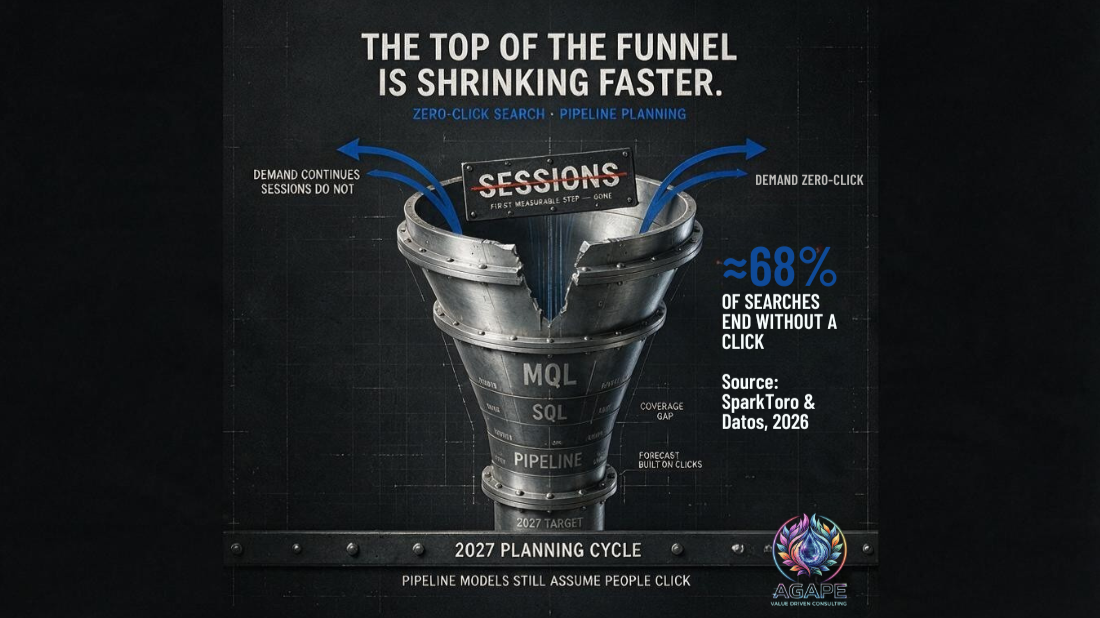
Standard organic search funnels exhibit severe attrition at enterprise deal stages. Out of every 10,000 visits arriving via Google organic search, 9,720 sessions fail to produce a sales-qualified enquiry - forcing customer acquisition costs upward as pipeline velocity stalls.
Search retains large budget allocations. Marketing teams continue directing the largest share of their acquisition budget planning toward standard search because its volume appears measurable on campaign dashboards and its cost per click remains visible in quarterly reports. This reporting bias creates an optical illusion of performance. B2B technology organizations maintain inflated search ad cost per lead metrics while overall customer acquisition costs climb steadily across legacy pipelines - leaving high intent traffic from AI assistant referrals completely untracked.
Buyers utilizing conversational interfaces behave differently from casual search users. A technical buyer engages an assistant to parse complex operational requirements, evaluate compliance parameters, and synthesize competitive matrices before clicking an outbound citation - arriving on the site with an executive shortlist already established.
Deconstructing the 14.2% referral benchmark
Precise capital decisions require empirical reference data from controlled B2B environments. Opollo evaluated GA4 and CRM records across 312 B2B technology and IT-services organizations between January 2025 and January 2026 - standardizing the definition of conversion around qualified enquiries, technical consultations, and validated product demonstrations. Mean conversion rates reached 14.2% for AI assistant referrals compared to the Google organic conversion 2.8% baseline. Median values confirmed this structural disparity at 13.6% and 2.5% respectively.
Methodological controls preserve the integrity of these findings. The study excluded accounts receiving fewer than 10 monthly assistant visits, eliminated outlier accounts exhibiting conversion rates above 35% , and verified a sustained 12.9% conversion rate among organizations processing over 100 assistant sessions per month. AI referrals outperformed organic search across 74% of analyzed firms.
This 2.8% baseline reflects organic search traffic. Conflating organic conversion benchmarks with paid search efficiency introduces strategic errors into channel mix optimization models - ignoring how auction-priced media depends on keyword intent, bid parameters, and immediate impression share.
Broader empirical evidence highlights significant variance across different market segments. A 6-month research study conducted by Amsive across 54 commercial websites documented a 4.87% conversion rate for large language model referrals alongside a 4.60% conversion rate for traditional search - establishing no statistically significant performance difference ( p=0.794 ). Single-company environments reveal dramatic efficiency spikes under specific product-led motions. Ahrefs reported that AI assistant referrals accounted for 0.5% of total website traffic while producing 12.1% of all customer sign-ups over a 30-day measurement window - demonstrating a 23x relative conversion multiplier. Adobe verified a 31% conversion increase from assistant-referred visits across more than 1 trillion consumer retail sessions during the 2025 holiday procurement cycle.
Macro benchmarks provide valuable reference points. Enterprise growth teams must evaluate conversion per channel against internal sales-accepted pipeline, qualified discovery meetings, and closed-won revenue.
Why do AI assistant referrals convert higher than Google organic search in B2B?
AI assistant referrals convert at 14.2% versus 2.8% for Google organic traffic because visitors arrive post-qualification - bypassing standard early discovery queries. Assistants interpret technical criteria, compare architectures, and filter vendors before delivering a citation, so the incoming referral represents an educated buyer reviewing an executive shortlist.
The unit economics of buyer-shortlist traffic
Evaluating channel efficiency requires mathematical normalization across identical traffic cohorts. Modeling a standard volume of 10,000 website sessions isolates the systemic economic impact across the underlying funnel math B2B models rely on:
AI assistant referrals at 14.2%: Yield 1,420 qualified enquiries from 10,000 incoming sessions. Google organic search at 2.8%: Yields 280 qualified enquiries from 10,000 incoming sessions. The efficiency gap: Establishes a 5.07x relative conversion multiplier favoring pre-qualified assistant traffic.
-
AI assistant referrals at 14.2%: Yield 1,420 qualified enquiries from 10,000 incoming sessions.
-
Google organic search at 2.8%: Yields 280 qualified enquiries from 10,000 incoming sessions.
-
The efficiency gap: Establishes a 5.07x relative conversion multiplier favoring pre-qualified assistant traffic.
Converting raw sessions into closed revenue requires rigorous qualification formulas. Growth leaders must govern their capital allocation through a defined operational equation:
Cost per qualified opportunity = channel-attributable investment ÷ sales-accepted opportunities
Analyzing pipeline generated per 1,000 incoming sessions reveals compounding advantages across the sales cycle. Every 1,000 sessions from AI assistants yield 142 qualified buyer interactions - compared to 28 qualified interactions generated by an equivalent volume of standard search traffic.
Commercial intent compresses sales cycles. Prospects entering through assistant shortlists possess defined technical requirements, validated operational budgets, and explicit implementation timelines - eliminating protracted introductory qualification calls.
Contract value preservation improves under this acquisition architecture. Buyers who discover solutions through structured technical syntheses bypass aggressive discount negotiations common in transactional search channels - sustaining higher average contract values and greater lifetime customer value.
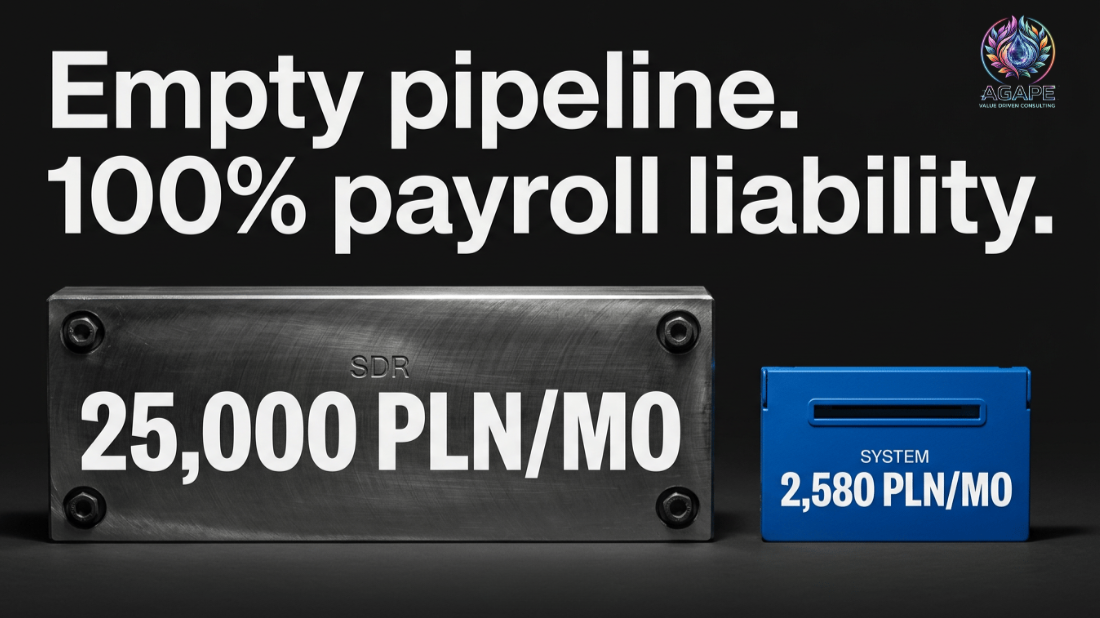
Traditional outbound sales alternatives introduce substantial fixed overhead. Staffing a standard B2B sales development representative incurs a total cost of ownership between 7,100 PLN and 25,000 PLN per month across base salary, social contributions, software tooling, and ramp-up overhead. Automated acquisition engineering delivers consistent enterprise discovery starting from 2,580 PLN net per month - creating severe cost arbitrage against manual prospecting workflows.
Constructing the enterprise attribution framework
Capturing buyer shortlist conversion requires complete analytics instrumentation across the measurement stack. Isolating assistant traffic requires building a dedicated custom channel inside GA4 to capture domains from ChatGPT, Perplexity, Claude, and Gemini - feeding these parameters directly through hidden form fields into CRM opportunity records. Growth teams must track session source, landing page paths, first-touch acquisition dimensions, and last-touch conversion points to evaluate cross-channel buyer movements.
Direct traffic spikes and branded search surges frequently mask upstream assistant interactions. Self-reported attribution fields on primary conversion forms provide the qualitative verification needed to resolve these blind spots - asking prospects to declare the exact source that introduced the brand.
Unclassified visits distort pipeline reporting. When a technical buyer evaluates an enterprise vendor inside an assistant and subsequently enters the website through a direct URL, standard analytics categorize the revenue as direct acquisition - obscuring the original discovery mechanism. Multi-touch pipeline modeling assigns appropriate weighting to the original AI synthesis.
Revenue attribution must enforce identical qualification criteria across every marketing pipeline - comparing AI referral traffic measurement against organic and paid search through uniform definitions of sales-accepted opportunities, discovery calls completed, and contract proposals delivered.
Capital allocation follows pipeline proof
Budget reallocations must follow validated CRM pipeline data. Marketing leaders must preserve branded search campaigns and high-performing non-brand paid groups that achieve internal target cost per opportunity thresholds. Paid search maintains an explicit commercial role when bids capture high-intent procurement queries with predictable conversion margins.
Optimization begins by auditing marginal non-brand search campaigns characterized by escalating costs per click and low opportunity conversion rates. Growth leaders identify the lowest-performing 15% to 25% of paid search spend - redirecting those underperforming resources into technical authority assets that earn assistant citations.
Assistant visibility requires structured assets. Building presence in conversational interfaces demands continuous investment in comparative technical documentation, detailed integration architecture specifications, third-party benchmark validations, and structured schema implementation.
Enterprise teams must run this allocation test across a full 90-day or 180-day enterprise sales cycle. Capital moves permanently only after internal CRM data proves that AI visibility delivers a lower cost per qualified opportunity and higher sales-accepted pipeline than legacy paid campaigns.
Capital allocation demands absolute measurement visibility across every acquisition layer. Dashboards lacking explicit AI referral tracking systematically misallocate capital into legacy channels with inflated acquisition costs.
Enterprise growth teams have two clear pathways to isolate this high-intent pipeline:
Access our complete technical blueprint on AI referral attribution modeling to configure custom GA4 channel groupings, CRM hidden parameter passing, and multi-touch opportunity weighting across your tech stack. Request a 20-minute pipeline architecture review with the AGAPE engineering team to audit your current analytics configuration and isolate hidden assistant traffic generating pipeline inside your CRM.
-
Access our complete technical blueprint on AI referral attribution modeling to configure custom GA4 channel groupings, CRM hidden parameter passing, and multi-touch opportunity weighting across your tech stack.
-
Request a 20-minute pipeline architecture review with the AGAPE engineering team to audit your current analytics configuration and isolate hidden assistant traffic generating pipeline inside your CRM.
This article was created with AGAPE's proprietary content machine AGAPE Liberty.
Frequently asked questions
Ready to evaluate fit?
Book a 25-minute discovery call and let's see if AGAPE is the right partner for your next campaign.
Schedule a 25-minute discovery call