Three months after the transparency obligations started to apply, EU AI Act Article 50 has reshaped enterprise sales operations across the European market. Corporate legal departments and enterprise risk committees are actively interrogating automated sequencer configurations, scraping tools, and generative personalization pipelines - moving outbound compliance from a hypothetical legal discussion directly into Q4 revenue operations.
On 2 August 2026, EU AI Act Article 50 established two transparency obligations that directly affect B2B outbound workflows - disclosing direct interactions with AI systems and labeling AI-generated content. These rules require verifiable disclosures across email and social sequences, enabling sales teams to run high-performing automation safely under full regulatory alignment.
The dual operational pressure facing enterprise sales teams
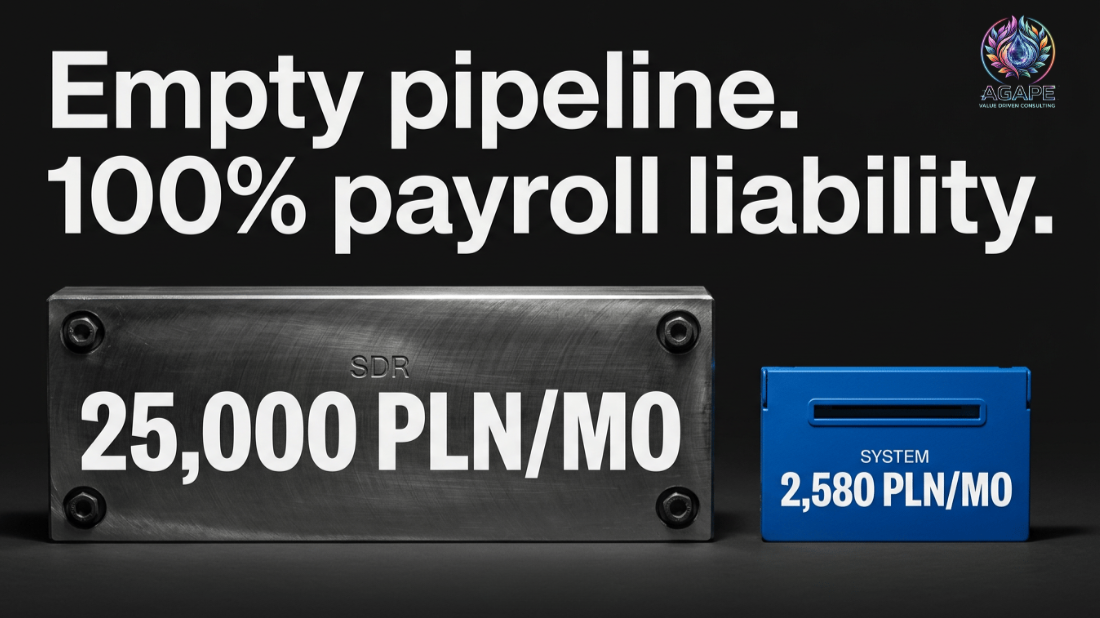
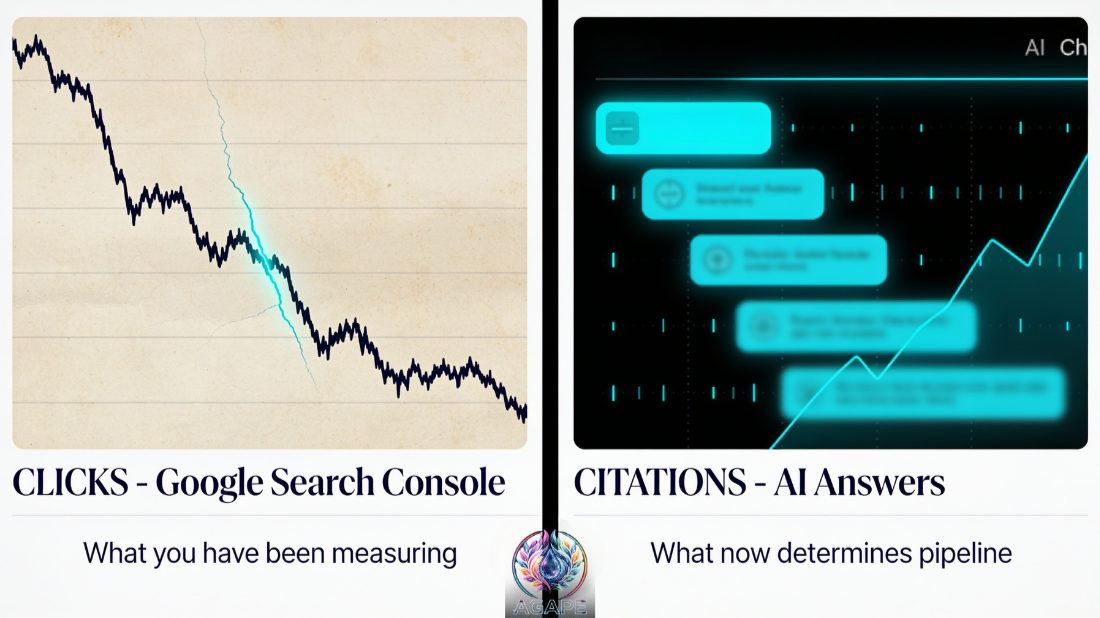
Revenue leaders operate in a brutally constrained commercial environment. Organic search visibility continues to erode across major industries, paid digital acquisition channels burn enterprise capital through record-high cost-per-click rates, and executive boards maintain strict hiring freezes on sales development representatives. Pipeline generation depends on automated outbound workflows.
An administrative shutdown of outreach systems represents an existential commercial threat. When sales automation tools face compliance inquiries, lead flow stops instantly - depriving account executives of qualified meetings while pipeline coverage collapses. Legal counsel focuses on three unquantified organizational threats: regulatory audit exposure, administrative liability, and public reputational damage.
The anxiety gripping commercial leadership stems from the uncertainty of technical compliance. Revenue leaders recognize that their teams rely on generative tools to draft, personalize, and sequence communications at scale - creating an urgent need for an engineering-grade system that satisfies the 2 August 2026 AI Act requirements while maintaining outreach momentum.
The two verifiable mandates of Article 50 in B2B sequences
Article 50 reduces in practice to two distinct, verifiable engineering requirements for automated outreach.
The first requirement governs direct AI interaction disclosure. When an outbound sequence utilizes an artificial intelligence system to interact with a prospective buyer, the system must inform the individual of that interaction. This disclosure provides commercial clarity - ensuring that enterprise buyers understand the technological nature of the communication channel.
The second requirement mandates clear AI generated content disclosure. Any outreach copy, customized proposition, or personalized email body generated by artificial intelligence must carry accessible provenance markers. Text produced through large language models must remain recognizable as generated material across the entire lifecycle of the campaign.
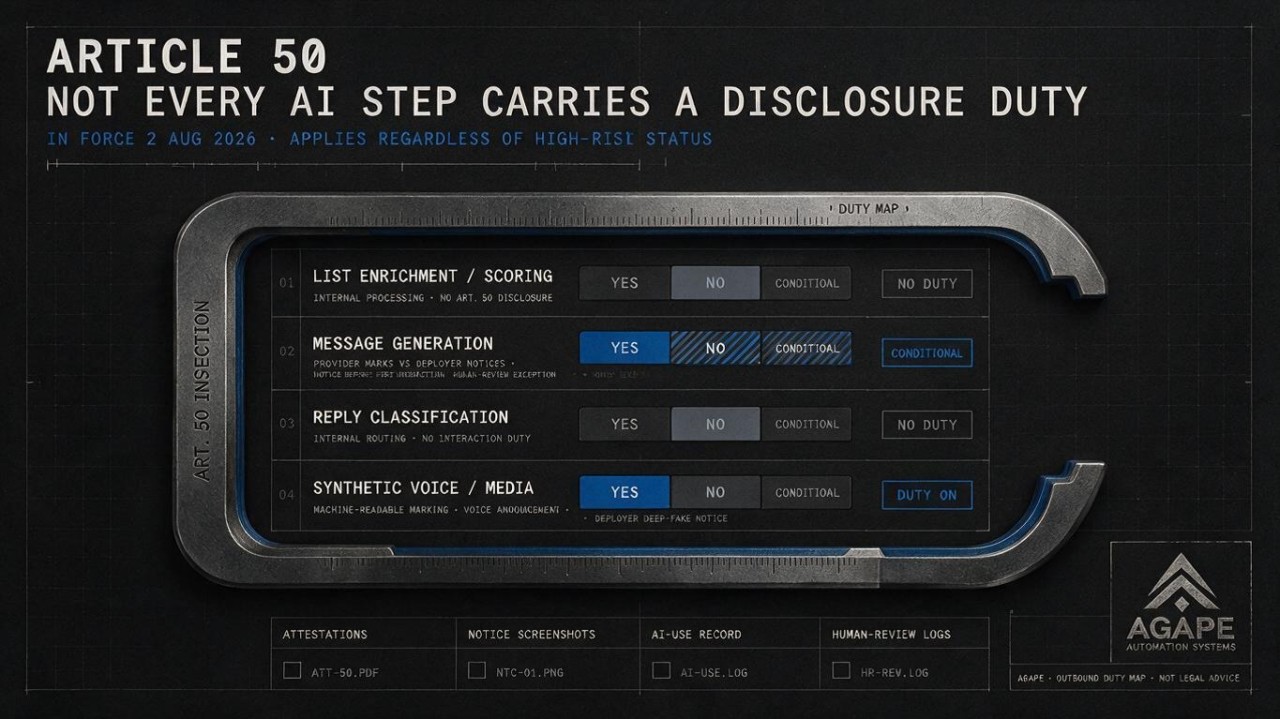
Understanding the legal scope of the regulation requires establishing its exact boundaries. Article 50 defines the transparency obligations that marketing teams must follow, yet it leaves foundational sales engineering practices intact:
Proprietary account scoring models and intent-data aggregation frameworks operate outside Article 50 transparency boundaries. Contact database hygiene, email deliverability protocols, and domain warming routines remain unaffected by content labeling rules. Algorithmic send-time optimization and dispatch throttling logic function without public-facing disclosure tags. Internal CRM routing rules and sales pipeline qualification stages stay entirely exempt from recipient disclosure requirements. Broader high-risk AI Act classifications exclude standard commercial messaging sequences - isolating outbound compliance strictly to Article 50 disclosure mandates.
-
Proprietary account scoring models and intent-data aggregation frameworks operate outside Article 50 transparency boundaries.
-
Contact database hygiene, email deliverability protocols, and domain warming routines remain unaffected by content labeling rules.
-
Algorithmic send-time optimization and dispatch throttling logic function without public-facing disclosure tags.
-
Internal CRM routing rules and sales pipeline qualification stages stay entirely exempt from recipient disclosure requirements.
-
Broader high-risk AI Act classifications exclude standard commercial messaging sequences - isolating outbound compliance strictly to Article 50 disclosure mandates.
Operational checklist: embedding compliance across outbound workflows
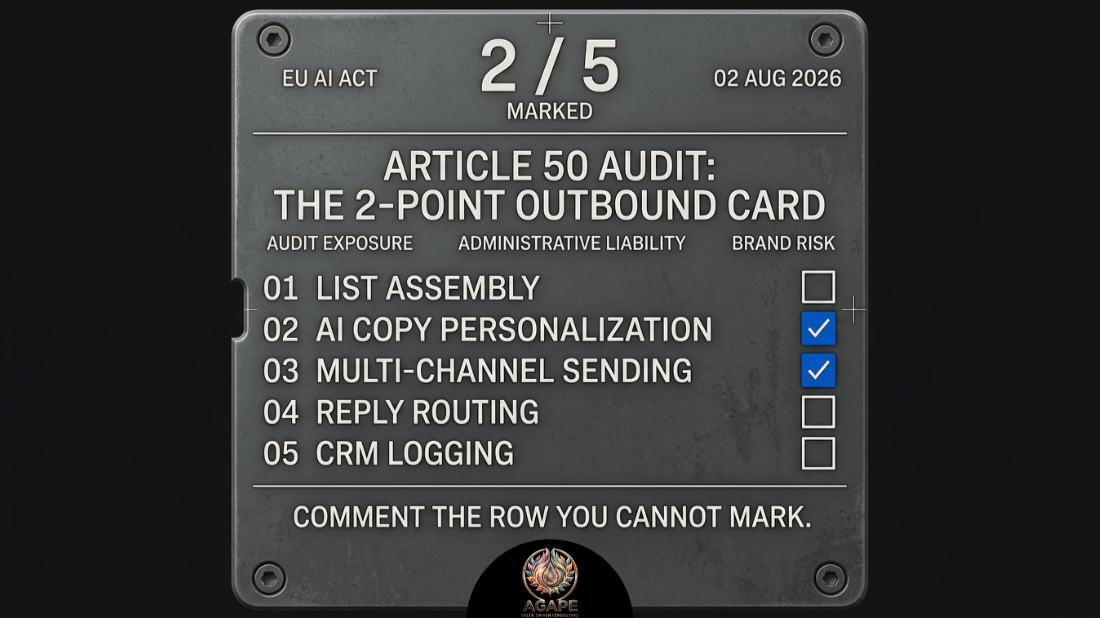
Transforming regulatory requirements into a reliable growth engine requires systematic implementation across every node of the outbound sequence. A complete compliance checklist maps these requirements across five specific stages of outbound architecture.
1. List sourcing and account enrichment
List sourcing and data enrichment remain fully outside Article 50 transparency mandates - allowing revenue operations teams to run automated account scoring and firmographic enrichment without consumer-facing disclosure markers. Data enrichment engines identify target accounts, append verified contact details, and calculate propensity scores inside the internal sales tech stack. Because these enrichment activities serve back-office analytical functions, they generate zero recipient-facing disclosure burdens.
Compliance integrity at this initial stage requires verifying that external enrichment APIs pass pure structured data into the sequencer. Systems maintain full regulatory compliance by storing raw firmographic variables - such as company headcount, tech stack indicators, and annual filings - as immutable database attributes, preparing them for downstream assembly.
2. Message drafting and generative personalization
Message composition represents the primary checkpoint for AI generated content disclosure. When personalization engines synthesize custom introductory lines, industry observations, or tailored value propositions, the resulting copy must display transparent origin markers.
Enterprise sales organizations implement non-intrusive disclosure micro-copy within outbound templates. Integrating AI disclosure in email footers and social messaging signatures preserves conversion mechanics while establishing verifiable compliance:
Email signature placement: 'Notice: Outbound research and message synthesis supported by AGAPE AI systems. Final communication delivered under human editorial oversight.' LinkedIn InMail footer micro-copy: 'System notice: Message drafting assisted by commercial AI tools.'
-
Email signature placement: 'Notice: Outbound research and message synthesis supported by AGAPE AI systems. Final communication delivered under human editorial oversight.'
-
LinkedIn InMail footer micro-copy: 'System notice: Message drafting assisted by commercial AI tools.'
Positioning disclosure notices within standard email signatures preserves message aesthetics. Prospects consume the commercial message naturally - absorbing the core value proposition while the signature block fulfills statutory interaction disclosure requirements.
3. Sending and multi-touch sequencing
Sequencing systems must maintain disclosure continuity throughout multi-touch cadences. Follow-up communications in an automated outreach campaign frequently generate shorter, contextual replies based on previous email threads. If an automated sequencer deploys artificial intelligence to craft follow-up steps, the interaction disclosure must remain present.
Engineering teams configure sequencer templates using persistent header and footer modules. When a sequencer dispatches step three or step four of an outbound campaign, the system programmatically binds the initial disclosure metadata to the active message container - guaranteeing that automated follow-up messages retain statutory transparency markers.
4. Reply handling and objection triage
Prospect engagement initiates the conversion phase of the outbound process. When a prospect responds with interest, scheduling availability, or commercial objections, sales workflows typically transition to human representatives.
Automated systems supporting this transition require clear boundary management. If an internal AI assistant analyzes the incoming reply to draft recommended response copy, revenue operations teams must enforce human validation gates:
Internal drafting tools generate suggested reply text directly into the sales representative's workspace. The human representative reviews, adjusts, and dispatches the final response. Fully automated reply bots - which send communications without human intervention - must include explicit interaction disclosure tags within the body text.
-
Internal drafting tools generate suggested reply text directly into the sales representative's workspace.
-
The human representative reviews, adjusts, and dispatches the final response.
-
Fully automated reply bots - which send communications without human intervention - must include explicit interaction disclosure tags within the body text.
Maintaining human-in-the-loop validation for inbound responses simplifies operational compliance while protecting high-value enterprise deal dynamics.
5. CRM logging and auditable system schema
Verifiable sales automation compliance requires immutable records of every dispatched message. When compliance officers or internal auditors inspect outbound operations, commercial teams must demonstrate proof of disclosure at the exact timestamp of transmission.
Organizations achieve audit-proof tracking by configuring dedicated custom fields within their CRM and sequencer databases:
ai_interaction_disclosed_bool: A boolean field recording the presence of mandatory disclosure copy at send time. ai_content_provenance_hash: A cryptographic string verifying the specific generative prompt version and model identifier. dispatch_timestamp_utc: A standardized record documenting the precise moment of message transmission. disclosure_location_tag: A categorical indicator logging whether disclosure occurred in the email footer, body text, or signature block.
-
ai_interaction_disclosed_bool: A boolean field recording the presence of mandatory disclosure copy at send time.
-
ai_content_provenance_hash: A cryptographic string verifying the specific generative prompt version and model identifier.
-
dispatch_timestamp_utc: A standardized record documenting the precise moment of message transmission.
-
disclosure_location_tag: A categorical indicator logging whether disclosure occurred in the email footer, body text, or signature block.
Capturing these variables systematically turns diffuse regulatory anxiety into structured, searchable operational records.
System architecture: maintaining pipeline velocity alongside compliance
High-performing outbound workflows thrive on technical precision. Compliant AI outreach succeeds when engineering teams integrate transparency controls directly into the foundational messaging architecture.
AGAPE approaches outbound engineering through deterministic message routing, zero-hallucination safeguards, and auditable data lineage. Rather than treating compliance as a defensive constraint, structured organizations leverage transparency to elevate brand credibility. Enterprise buyers respect transparent, precise commercial outreach - rewarding clear professional communication with higher engagement and sustained meeting conversions.
Commercial teams that master these two core mandates run automated systems with absolute operational confidence. By anchoring transparency disclosures inside standard sequence templates and recording compliance data across CRM pipelines, organizations preserve outbound as an efficient, predictable revenue engine.
Notice: This publication provides operational analysis of sales automation workflows and does not constitute formal legal counsel; organizations must consult qualified legal professionals for bespoke statutory interpretation.
Which specific step of your outbound workflow are you least confident about under the Article 50 transparency rules? Share your technical setup and observations in the comments to compare frameworks with other revenue leaders.
This article was created with AGAPE's proprietary content machine AGAPE Liberty.
Frequently asked questions
Ready to evaluate fit?
Book a 25-minute discovery call and let's see if AGAPE is the right partner for your next campaign.
Schedule a 25-minute discovery call