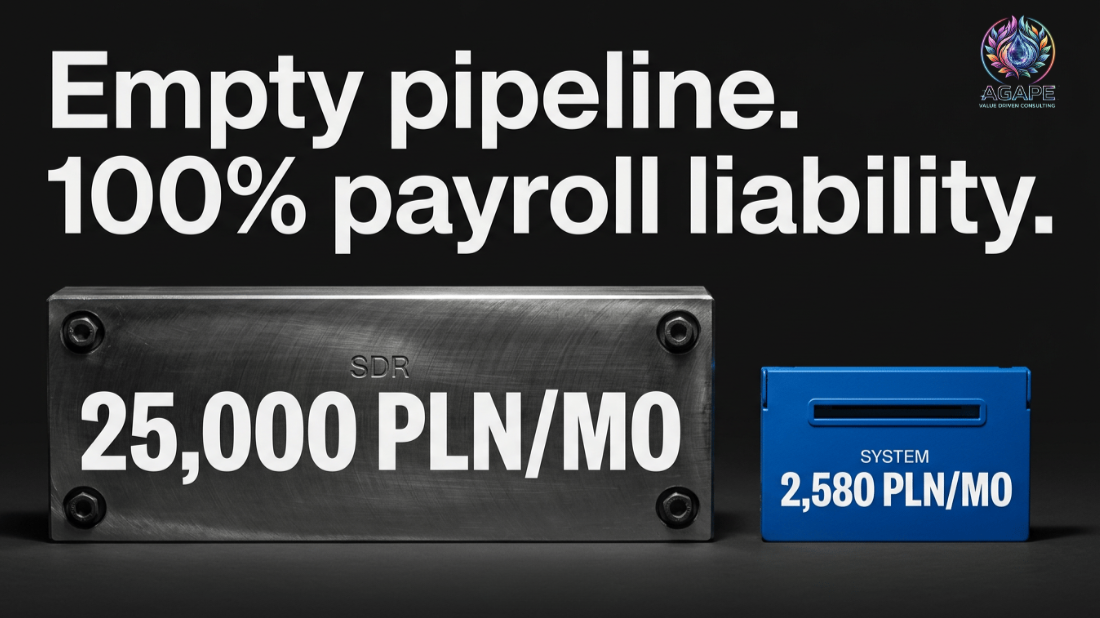
A complete outbound system operates at a fixed 2,580 PLN per month, standing in direct contrast to an internal sales hire whose fully loaded cost ranges between 7,100 PLN and 25,000 PLN every single month.
Fixed liabilities demand mathematical justification. When executive leadership evaluates sales rep cost per month against verified outbound automation pricing, hiring an internal representative reveals itself as an aggressive balance-sheet liability that must prove its value against an agile operational expense.
Founders of 2-200-person B2B enterprises confront quarterly commercial targets that require systematic pipeline generation - yet traditional hiring assumptions consistently burden corporate balance sheets with excessive fixed costs long before the first qualified appointment materializes.
The real burden of building an internal sales team
Headcount math remains unforgiving.
A newly hired sales representative enters the company ledger on day one - generating legal payroll exposure, statutory social contributions, enterprise software licensing fees, and recurring vehicle fleet obligations weeks before executing an initial prospecting touchpoint.
The standard SDR ramp time consumes 6 months of continuous cash outflow before the representative approaches consistent quota attainment. Throughout this ramp phase, executive leadership funds the entire financial liability while calendar density remains low and commercial revenue targets stall.
When operational prospecting finally begins, internal friction frequently stalls pipeline execution. One experienced B2B founder outlined the exact ground-level reality confronting expanding commercial teams:
"Sales reps expect leads handed to them on a platter, while call centers book us meetings with people lacking grid connection conditions for a PV farm. We waste thousands on pointless audits and field trips."
This breakdown reveals the fundamental structural defect inside conventional sales expansion. Commercial account executives demand warm inbound leads while declining the repetitive labor of outbound research - leaving lead generation completely unaddressed.
Simultaneously, outsourced call centers prioritize call volume over technical qualification, booking meetings with prospect accounts that lack baseline feasibility requirements such as medium-voltage grid capacity or authorized building permits.
Internal engineering specialists subsequently waste billable hours traveling across regions to perform comprehensive site audits on properties that were disqualified before the visit began. Operational capital disappears into travel expenses, engineering wages, and administrative overhead while actual contract volume remains unchanged.
Six-month and twelve-month cost comparison
A side-by-side financial model illustrates the structural capital exposure inherent in internal commercial hiring versus an automated outbound architecture.
Internal SDR vs outbound system, line by line:
Monthly cost: 7,100-25,000 PLN vs 2,580 PLN 6-month total: 42,600-150,000 PLN vs 15,480 PLN 12-month total: 85,200-300,000 PLN vs 30,960 PLN Salary, equipment, car and fuel during ramp: paid in full, zero pipeline vs not applicable First qualified meetings: around month 6 vs within 14-28 days If no qualified meetings appear: the company absorbs 100% of the loss vs cancel a monthly invoice
-
Monthly cost: 7,100-25,000 PLN vs 2,580 PLN
-
6-month total: 42,600-150,000 PLN vs 15,480 PLN
-
12-month total: 85,200-300,000 PLN vs 30,960 PLN
-
Salary, equipment, car and fuel during ramp: paid in full, zero pipeline vs not applicable
-
First qualified meetings: around month 6 vs within 14-28 days
-
If no qualified meetings appear: the company absorbs 100% of the loss vs cancel a monthly invoice
Operational expenditure comparison
Examining this hire-versus-system comparison across multi-rep commercial teams exposes severe financial vulnerabilities.
Scaling a commercial division to two or three representatives amplifies baseline overhead to 14,200-75,000 PLN each month - locking corporate cash reserves into payroll liabilities during volatile economic conditions.
Capital exposure compounds rapidly across cohorts. When an enterprise carries three parallel representatives through the mandatory ramp phase, onboarding overhead consumes hundreds of thousands of zlotys in liquid reserves while total commercial output remains unproven.
Recruiter turnover introduces another critical balance-sheet hazard. Commercial development representatives frequently depart before their ramp investment pays back, with underperforming personnel often leaving inside the first year of employment.
When a representative leaves before the ramp completes, the entire commercial ramp interval resets to day zero - forcing the enterprise to write off up to six months of fully loaded payroll, between 42,600 PLN and 150,000 PLN , as unrecoverable onboarding capital.
Physical workstation assets, software contracts, and multi-year vehicle leases remain locked on the corporate balance sheet while the position sits vacant across a 30-day recruitment freeze.
Deploying the 2,580 PLN monthly outbound system establishes engineering stability across the acquisition pipeline. The outbound architecture runs continuously, routing high-priority decision-makers directly into executive calendars while corporate expenses remain locked to a single, predictable monthly invoice.
What hiring an SDR really costs versus the system
An internal SDR requires 7,100-25,000 PLN in fully loaded monthly expenses alongside a 6-month ramp window before producing pipeline results. An outbound automation system costs 2,580 PLN monthly, deploying verified infrastructure within 14-28 days to deliver qualified B2B meetings continuously while restricting financial commitments to a predictable, fixed operating expense.
This performance differential transforms commercial budget allocation. The total cost of ownership for a sales rep includes recruitment fees, specialized management hours, payroll accounting, and inevitable software bloat - factors that routinely push the real cost of hiring a sales rep far beyond base compensation.
Operating an automated architecture establishes financial clarity. Outbound automation pricing provides complete cost transparency, enabling commercial teams to forecast customer acquisition expenses with mathematical precision.
Predictable pipeline without long-term payroll commitments
Leadership teams evaluating 2027 sales headcount budgets recognize that technical deliverability forms the foundation of modern appointment setting. Traditional sales hires frequently attempt aggressive, uncalibrated email campaigns that trigger spam filters and result in corporate domains getting blacklisted across primary exchange servers.
Domain recovery requires months of technical remediation. During a domain blacklist event, routine corporate communications fail alongside sales outreach, paralyzing broader operational workflows and damaging client trust.
Isolated sending environments preserve root domain authority across all prospect interactions. Dedicated outbound infrastructure isolates outreach sequences across secondary domains, authenticated via strict SPF, DKIM, and DMARC protocols to protect sender reputation and sustain strong acceptance rates on target networks.
This technical framework secures reliable appointment acquisition at a known, fixed appointment-setting cost. The enterprise maintains consistent outreach volume, turning commercial prospecting into a reliable engineering system that operates independently of employee churn.
Predictable pipeline without hiring expands operating leverage across every commercial quarter. Leadership teams deploy reliable outbound acquisition models while preserving balance-sheet capital for core product development, customer delivery, and strategic executive hires.
Q4 budget planning and the next decision point
Approaching annual planning cycles force executive teams to resolve commercial quota deficits before year-end financial closing. Comparing SDR salary with outbound service requirements demonstrates that traditional hiring introduces structural capital risk during moments that demand rapid pipeline execution.
Running a rigorous hire-versus-system analysis shifts the enterprise from unpredictable headcount liabilities toward reliable, process-driven revenue generation. Q4 sales budget planning rewards organizations that secure high-value commercial appointments while preserving working capital through variable operating models.
To establish clarity on your firm's commercial acquisition costs and eliminate pipeline guesswork:
Download the Q4 Outbound Financial Modeling Worksheet: Calculate your company's precise internal SDR capital exposure, factoring in local taxation, vehicle fleet leasing, equipment depreciation, and ramp delay costs against an automated system architecture. Schedule a 20-minute Pipeline Architecture Audit: Meet directly with our technical systems team to evaluate your current domain deliverability health, assess prospect data hygiene, and map an automated outbound integration for your enterprise.
-
Download the Q4 Outbound Financial Modeling Worksheet: Calculate your company's precise internal SDR capital exposure, factoring in local taxation, vehicle fleet leasing, equipment depreciation, and ramp delay costs against an automated system architecture.
-
Schedule a 20-minute Pipeline Architecture Audit: Meet directly with our technical systems team to evaluate your current domain deliverability health, assess prospect data hygiene, and map an automated outbound integration for your enterprise.
This article was created with AGAPE's proprietary content machine AGAPE Liberty.
Frequently asked questions
Ready to evaluate fit?
Book a 25-minute discovery call and let's see if AGAPE is the right partner for your next campaign.
Schedule a 25-minute discovery call