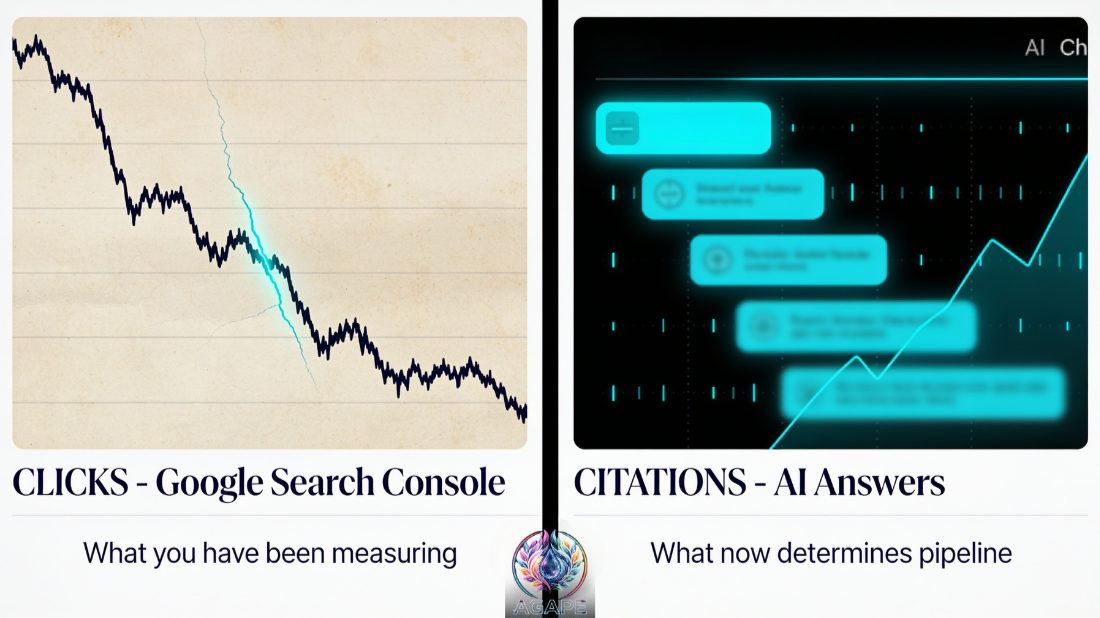
"We publish every week, yet traffic keeps falling, and I no longer know what else we should do." This exact sentiment surfaces in conversations with technology CMOs and VPs of Sales who open Google Search Console each month and confront a sustained downward curve even though their content calendar has executed without interruption. The decline registers as personal failure until the data reveals a structural mechanism that has altered the economics of informational search itself.
The Structural Shift From Clicks to Answers
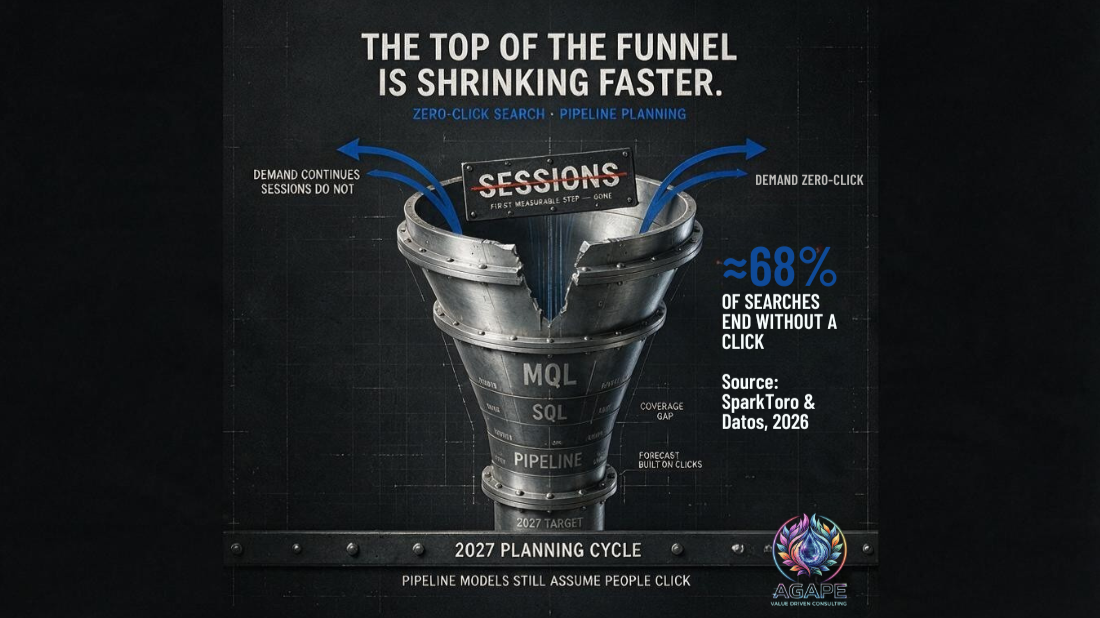
SparkToro's analysis of Similarweb clickstream data found that 68.01% of US Google searches ended without a click in the first four months of 2026 - up from 60.45% in 2024 and roughly 49% in 2019 - so that only 276 of every 1,000 US searches produced a click to the open web. (An earlier 2024 SparkToro and Datos study reported 360 clicks per 1,000 US searches; that figure describes 2024, not the current baseline.) Bain & Company and a separate cross-industry aggregation by Omnibound corroborate the trend from different angles, each finding double-digit organic traffic declines across B2B and consumer sectors alike. These figures describe the new market baseline, not a failing content plan.
A randomized field experiment by Saharsh Agarwal (Indian School of Business) and Ananya Sen (Carnegie Mellon University) isolates the cause. Conditional on appearing, AI Overviews reduced outbound organic clicks by 39.8% and increased zero-click searches by 34.5%, with the effect concentrated when the summary appeared at the very top of the page - removing a top-position AI Overview nearly doubled outbound clicks. An endline satisfaction survey found no meaningful difference between users who saw AI Overviews and those who did not, indicating the shift toward zero-click behavior is a platform-imposed substitution rather than something users are choosing for a better experience.
Digital Content Next tracked the click-through rate of the number-one organic result on AI Overview keywords and recorded a collapse from 7.3% to 2.6% between March 2024 and March 2025, showing that even a top ranking no longer guarantees a visit.
Pew Research Center found users clicked a traditional result only 8% of the time when an AI summary appeared, versus 15% when none appeared. These outcomes occur while rankings remain stable, which explains why weekly publishing no longer restores the sessions that once followed position one.
Where Buyer Research Has Migrated
G2's March 2026 survey of 1,076 B2B software buyers and decision-makers found that 51% now start research with an AI chatbot more often than with Google - up from 29% just eleven months earlier. 6sense's 2025 Buyer Experience Report found that 94% of B2B buyers used generative AI tools to summarize reviews or analyze data during their purchase process, confirming this is standard buying-committee behavior rather than an early-adopter fringe. Reported OpenAI platform metrics put ChatGPT at roughly 2.5 billion queries per day by mid-2025 and 900 million weekly active users by early 2026, and Adobe analytics recorded AI-driven referral traffic to US retail sites surging during the 2025 holiday season. Gartner has projected that traditional search engine volume could drop meaningfully by 2026 as AI chatbots and virtual agents absorb a growing share of queries. The addressable volume of classic search is shrinking, and the first questions from a multi-person buying committee increasingly land inside assistants that Google Search Console does not measure.
Redefining the Scoreboard
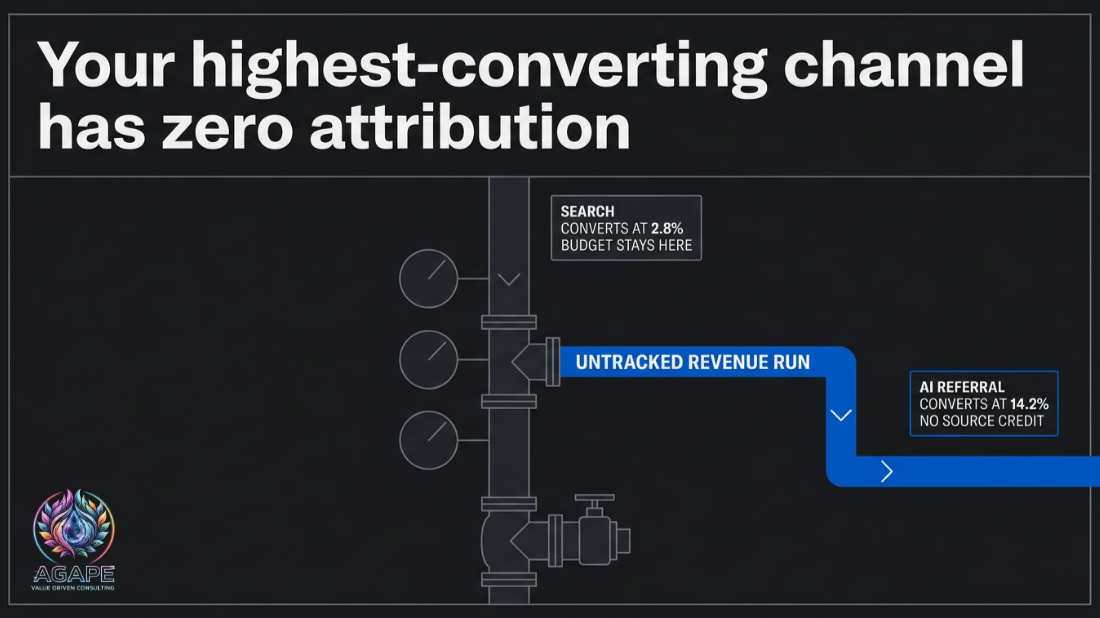
Impressions, clicks, citations, branded demand, AI referrals, and qualified conversions now need to be tracked separately. Impressions and clicks inside Search Console continue to matter for branded and transactional queries, yet they no longer capture the full picture of early-stage visibility. Citation share inside AI-generated answers, brand presence when category-level questions are posed to ChatGPT or Perplexity, assistant-referred sessions and conversions recorded in GA4, and engagement depth become the operative metrics. A Seer Interactive GA4 case study covering October 2024 to April 2025 showed Google organic traffic converting at 1.76 to 1.8% while ChatGPT-referred traffic converted at 15.9%, Perplexity at 10.5%, Claude at 5%, and Gemini at 3% in the account studied. Although AI sources accounted for a small fraction of organic traffic in that account, they generated meaningfully more conversions than the previous year - a single-account finding, not a guaranteed multiplier, but directionally consistent with the idea that fewer sessions can still produce more pipeline when the sessions that do arrive carry higher intent. Separate analysis found that visitors arriving from AI search tools spend noticeably more time on site than visitors from traditional organic search.
Practical Steps Toward Answer-Ready Assets
Question-led titles, BLUF answers placed in the first paragraph, concise citable passages, original evidence, consistent entity references, Article and FAQPage schema where valid, clean sitemap and robots.txt hygiene, and independent references increase the probability that an asset is selected and summarized. llms.txt serves as a secondary signal whose value remains evidence-limited at present - worth doing, but not a substitute for the fundamentals above. These practices create machine-readable content that can earn citations whether or not a click follows.
A 20-query test provides an immediate visibility baseline. Run the same set of category and problem-definition queries through both ChatGPT and Perplexity, record whether the brand is named or cited, note the exact phrasing of any summary that appears, and log any linked sources. Repeat monthly. The resulting log reveals citation share and surfaces gaps that traditional ranking reports miss.
The New Outcome
Weekly publishing remains an asset. The measurement model that once translated that publishing directly into sessions has expired. 6sense's own research finds that the vendor already on a buyer's day-one shortlist wins the deal 85 to 95% of the time. Brands that earn citations where the majority of searches now terminate without a click, and where buying committees ask their first questions, position themselves on that shortlist. The traffic line on the dashboard may continue to trend downward while the pipeline contribution from AI-referred visitors rises.
We are curious how you interpret the traffic decline despite publishing consistently - and whether your brand appears when you run a 20-query test across ChatGPT and Perplexity for your own category.
This article was created with AGAPE's proprietary content machine AGAPE Liberty.
Frequently asked questions
Ready to evaluate fit?
Book a 25-minute discovery call and let's see if AGAPE is the right partner for your next campaign.
Schedule a 25-minute discovery call