95% of email replies land within the first 24 hours. Only 2.8% arrive later.
Your discovery call disappears into silence. The follow-up sounds like a bot. It isn't fit to be forwarded inside the client's organization. This isn't a channel problem. An analysis of 7.5 million B2B records (Leadquasar, 2026) shows that 99% of decision-makers have a working email address. The problem lies in the content. Content that doesn't hold up inside internal circulation.
The mechanism behind post-discovery silence
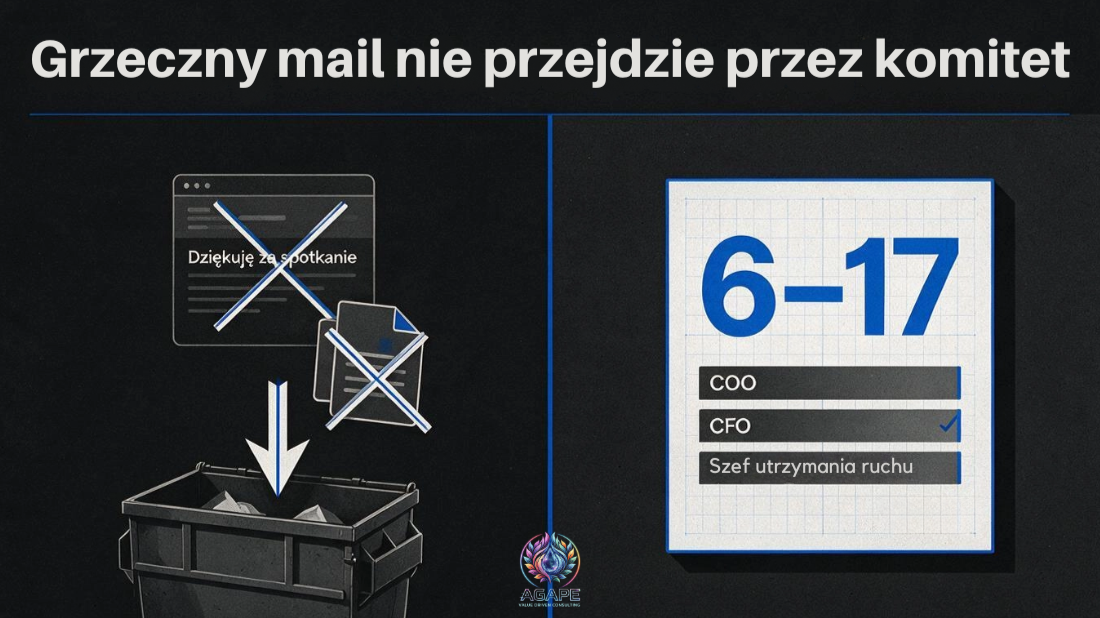
CEOs and COOs of B2B SMEs lose control over margin. The specific findings from the discovery call get blurred in operational noise. The person on the call is rarely the only decision-maker. A standard B2B purchase involves 6-10 stakeholders. Complex decisions involve 11+ people. In large strategic contracts, the average is 17 contacts (Greve.io, Derrick, Gartner, 2026). The bigger the deal, the more people read the follow-up without having taken part in the conversation. The message must be a self-sufficient internal document.
The maintenance director is putting out fires on the packaging line. The CFO is calculating pressure on EBIT. The operations director's inbox is a mix of plant alerts, quality audits, and supplier tickets. Emails with a marketing tone are classified as spam within seconds. They don't anchor themselves in the plant's specifics. A follow-up should sound like an internal memo. A document for someone who wasn't in the meeting.
The follow-up must immediately reflect concrete losses. 3 breakdowns last quarter. 40,000 PLN each. 120,000 PLN total. Only then does the client's champion get material to argue with. They can pass it to the operations director, the CFO, and the head of maintenance without additional explanation.
For a few dozen minutes after the call, the client still remembers their own numbers, words, and emotions from the conversation. It's a mental snapshot. A follow-up sent within that window recalls the same words and numbers again. It fixes them as a document. After 24 hours, the snapshot gets overwritten by new alerts, emails, and operational problems.
Four blocks of an effective follow-up
An effective message sent within 24 hours of discovery consists of four elements. Together they form a document ready to circulate inside the client's organization. The structure below is a heuristic based on market practice. Test it as a pilot. The Yesware and Leadquasar figures are hard numbers with a stated year and source.
Block 1: A summary of the client's problem. One or two sentences. The recipient recognizes their own plant. Not a generic industry case. You use their words and their numbers.
Block 2: The consequences of maintaining the status quo. Operational and financial. Hours of downtime. Material losses. Impact on margin. You show the cost of inaction.
Block 3: One next step with a deadline. An exact date. An assigned owner. One clear call to action. Knowlee data (2026) shows that multiple CTAs cut response rates by nearly 2x.
Block 4: One piece of material for the person who wasn't there. A short risk map. A mini process audit. Something that can be passed to the CFO or the head of maintenance. New information, not a repeat of the conversation.
This structure acts like a confirmation protocol. The client sees their own numbers and their own problem. They don't need to translate anything. The document is ready for internal circulation.
What to send after the meeting: what to avoid in a follow-up
Silence after a discovery call starts with these mistakes:
-
A multi-page presentation without context.
-
Corporate language like "we are delighted to present our offer."
-
Several CTAs at once.
-
A generic "let me know what you think."
A specific date and scope for the next meeting replace a generic "let me know what you think." A late follow-up is a signal to the client: "They don't have control over their own pipeline. What will implementation look like?" If a competitor sent their summary faster, your email becomes evidence in the committee's hands. Someone else has a better process.
The value of a fast 24-hour follow-up
The window doesn't close after 24 hours. It practically closes after the first hour. The 24-hour mark is the boundary of statistical noise. 42% of replies land within the first hour. 75% within the first four hours. 95% within 24 hours. Only 2.8% later (Yesware).
Sending a follow-up within 24 hours raises the average response rate to around 25% (Yesware, 2024 data). A fast follow-up is a signal of process discipline. The supplier is in control of its own pipeline. It's a credibility test before implementation.
A follow-up after discovery is an internal document. The structure of the post-call email decides whether the message circulates within the organization. A presentation without context doesn't circulate.
What was in your last post-discovery follow-up? A specific number and a deadline? Or just "thank you + presentation"? Write it in the comments.
This article was created with AGAPE's proprietary content machine AGAPE Liberty.
Frequently asked questions
Ready to evaluate fit?
Book a 25-minute discovery call and let's see if AGAPE is the right partner for your next campaign.
Schedule a 25-minute discovery call