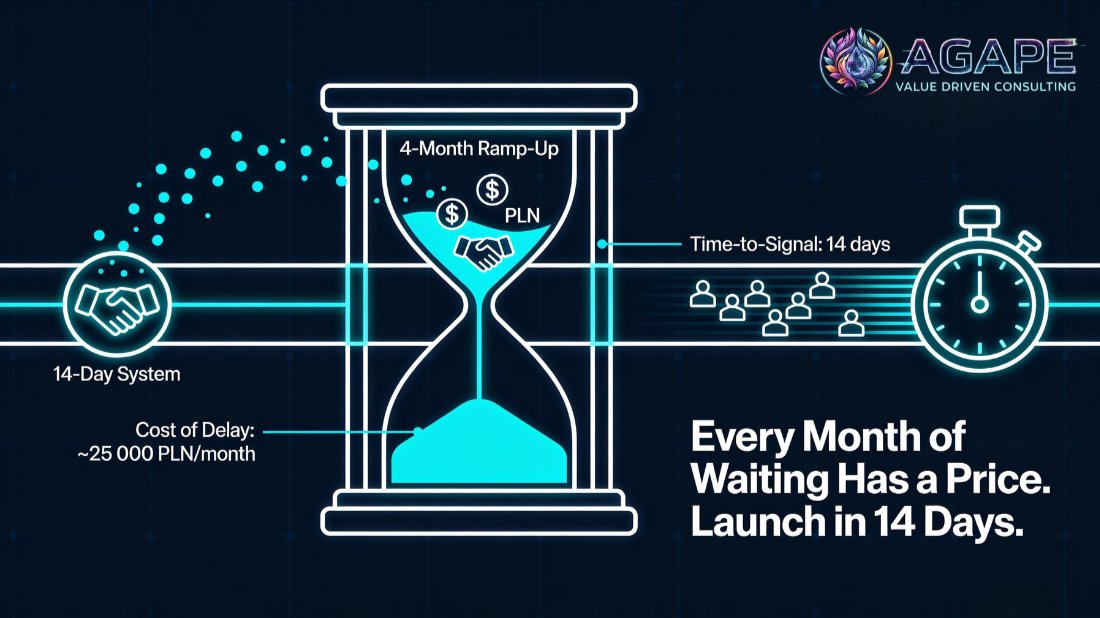
The Hidden Costs of the Traditional Sales Calendar
In the world of Industry 4.0, speed is the ultimate currency. Yet, a critical delay is built into the very foundation of how most companies grow their sales teams: the four-month ramp-up period. While a new salesperson draws a full salary from day one, it takes an average of 120 days before they begin generating a return on that investment. During this time, your competitors are closing deals. This exact tension—the gap between capital commitment and reliable market feedback—now defines competitive positioning more than sales headcount alone.
Decoding the Four-Month Ramp-Up
This four-month timeline isn't an anomaly; it's a data-backed industry standard. DealHub's ramp-time benchmark analysis, which cites HubSpot data, places the average between 3.2 and 3.5 months. That's roughly 105 days just to reach full quota attainment. Optifai's productivity curve visualizes this slow progression in stark terms:
- Month 1: 0–10% productivity
- Month 2: 30% productivity
- Month 3: 60% productivity
- Month 4: 100% productivity
During this period, industry benchmarks confirm that key metrics like win rates and forecast accuracy are severely depressed. A representative still learning the Ideal Customer Profile (ICP) cannot qualify opportunities with the precision of a mature system, leading to a pipeline filled with opportunities that consume time but never close. Nutshell’s guide to onboarding highlights that in complex sales environments, this period often stretches to six or even twelve months. The first deal might close around day 45, but the first two months are dominated by internal training, shadowing, and research.
Even with best-practice onboarding methodologies like those from RAIN Group—involving structured mentorship and daily coaching—the fundamental constraint remains. A human must absorb vast domain knowledge, build internal and external relationships, and develop sound judgment before they can produce a reliable pipeline. A configured outbound system, in contrast, bypasses this entire learning curve.
The Financial Drain of Waiting
The cost of this waiting game is staggering. Talent Bridge's European analysis estimates that total recruiting and onboarding costs can exceed $90,000 USD per representative. When you factor in lost sales opportunities during the ramp-up, Nutshell quantifies the average cost of turnover at approximately $97,690 USD.
Focus Digital's 2026 report adds another layer of urgency. The median B2B sales cycle is now near 84 days, with manufacturing deals averaging 125–130 days. For contracts over $500,000 USD, this can extend to 270 days. Compounding the issue, Chambr.ai's 2026 benchmarks reveal that the average ramp time for account executives has lengthened from 4.3 months in 2020 to 5.7 months today. Using the cost-of-delay framework from Product School, every month a high-value industrial contract is postponed translates to tens of thousands of PLN in lost profit.
The 14-Day Launch: An Automated Outbound System
What if you could bypass the ramp-up and get your first market signal in just 14 days? A well-designed outbound system fundamentally changes the calendar by compressing the initial setup into a two-week sprint:
- Infrastructure Configuration: Setting up the necessary tools and accounts.
- ICP Definition & Target Account Selection: Precisely defining who to contact.
- Messaging Approval: Crafting and finalizing compelling outreach copy.
- Sequence Activation: Launching the multi-channel campaign.
Highspot’s 2026 sales automation analysis confirms the efficacy of this approach. Replies, discovery calls, and early-stage opportunities begin arriving within the first 14 to 28 days of operation. The system acts as a pre-revenue compressor, generating a stream of qualified conversations that can be handed to incoming or ramping representatives, allowing them to be productive immediately.
Redefining Pipeline Velocity
This compression has a direct and powerful impact on pipeline velocity, which is calculated as:
(Number of Opportunities × Average Deal Size × Win Rate) ÷ Sales Cycle Length
An automated system begins populating the numerator—the 'Number of Opportunities'—weeks or even months before a new hire would even start prospecting. When the first qualified meetings land in week three instead of month three, the entire revenue engine shifts left. Tam To Target’s SDR meeting benchmarks show this is not a theoretical benefit, with systems achieving a steady-state output of 12 to 15 qualified meetings per month, and top performers hitting 18-20. Automation manages lead routing, follow-ups, and CRM updates, freeing your human sellers to focus on high-value discovery, negotiation, and closing.
Clarifying the System's Role and Economic Impact
It is crucial to understand what this system does and what it does not do. It is not a replacement for skilled salespeople; it is a powerful force multiplier.
Man and Machine: A Symbiotic Relationship
The system's job is to compress the time between investment and evidence. It delivers a reliable, qualified stream of conversations, proving that your market strategy is working. It handles the repetitive, time-consuming work of top-of-funnel engagement. However, meetings and opportunities are not revenue. Executing the sales cycle and closing complex deals still requires human judgment, relationship-building, and nuanced negotiation. The system hands the baton to your sales team at the perfect moment, empowering them to do what they do best.
The Smart Math: Fixed Subscription vs. Success Fees
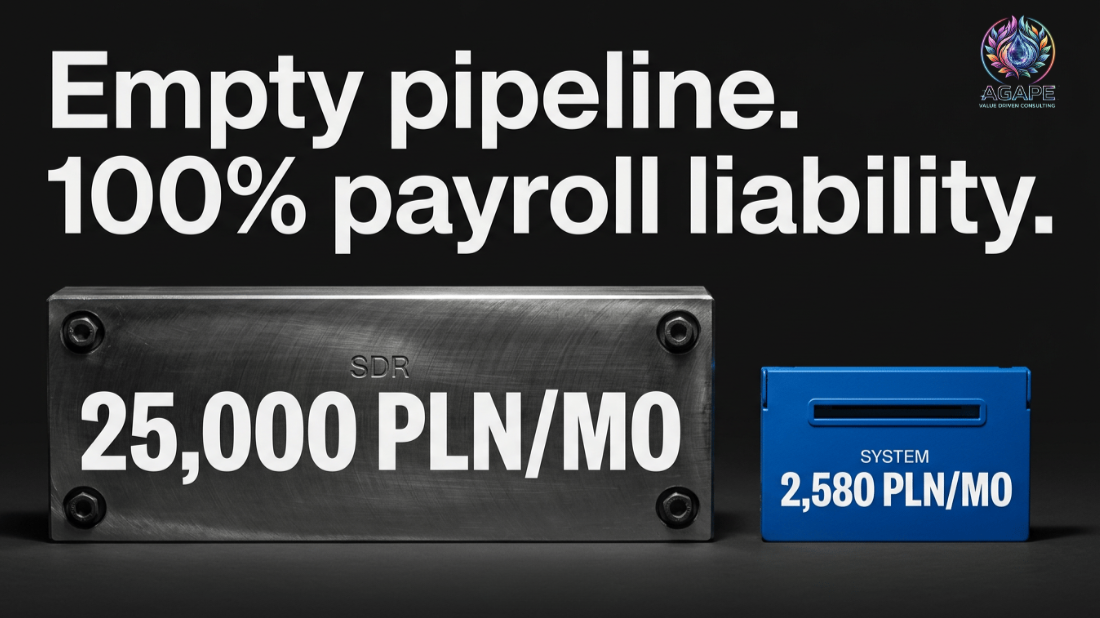
The economic model is as critical as the timeline. As analyses from both ClientIR and Clutch establish, 100% success-fee lead generation models can decimate your profit margins, taking tens of thousands of PLN from every signed industrial contract. A fixed subscription model, by contrast, protects your margin and provides a predictable, scalable cost structure. The investment is tied to a process, not a penalty on your success.
The strategic question is no longer whether to invest in sales, but how to get the fastest, most reliable signal that the investment is working. The choice is between waiting four months for a person to ramp up or waiting fourteen days for a system to deliver results.
Your Path to Accelerated Growth
Are you ready to swap the four-month waiting game for a fourteen-day launch? The next move is simple.
Message AGAPE with the word RAMP to receive a detailed timeline template that maps your current onboarding process against our fourteen-day alternative. Or, book a complimentary 20-minute implementation review to see exactly how our system would operate alongside your existing team to drive immediate results.
This article was created with AGAPE's proprietary content machine AGAPE Liberty.
Frequently asked questions
Ready to evaluate fit?
Book a 25-minute discovery call and let's see if AGAPE is the right partner for your next campaign.
Schedule a 25-minute discovery call