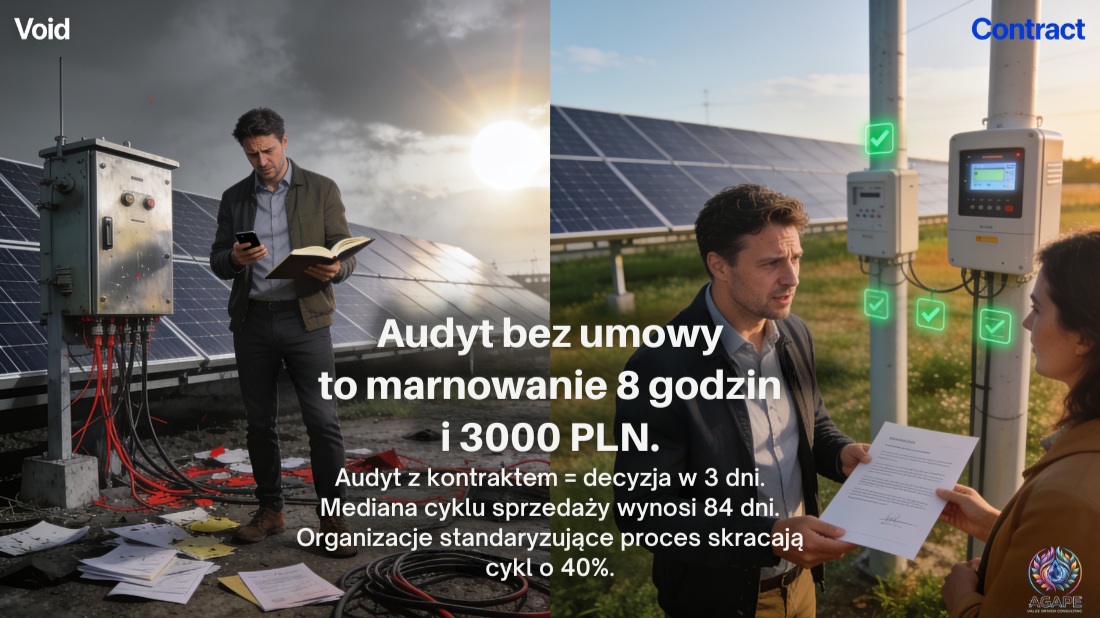
The Sound of Silence: The Cost of Unstructured Follow-Ups
Every B2B sales professional knows the feeling. You leave a promising meeting, send a summary email, and then... silence. Without a pre-agreed framework for what happens next, this silence can be interpreted in countless ways, leading to a cycle of anxious, often desperate follow-ups.
In the high-ticket B2B SME and SaaS sectors, the median sales cycle is a lengthy 84 days. This duration is heavily influenced by the contract size and, crucially, the quality of process management. Organizations that standardize and simplify the stages from initial discussion to final signature can shorten their sales cycles by as much as 40%. This translates directly to faster revenue recognition and a lower risk of losing the deal.
The Pain of a Process Vacuum
In demanding industries like renewable energy, the lack of an agreed-upon process creates significant pain points. Sales teams complain about being sent on pointless site audits, while management laments wasted resources on leads who lack the basic qualifications, such as grid connection permits for a PV farm.
When an up-front contract is missing, the follow-up becomes an act of desperation rather than the execution of a jointly planned step. Your CRM pipeline fills with aging opportunities that are neither 'lost' nor have a clear next action. These 'zombie deals' distort sales forecasts and erode the credibility of your reporting.
Statistics highlight the challenge. In typical follow-up sequences, 58.6% of all replies come between the second and sixth contact attempts. Furthermore, over half of all meetings are secured only on the third contact or later. While persistence is key, it must be structured. Data from Belkins suggests an optimal sequence of 3-5 steps, after which the returns diminish significantly. Avoma recommends a follow-up within 24 hours, another after 2-3 days, and a full sequence spread over 2-3 weeks. However, these frameworks are only effective if the client has agreed to this rhythm in advance. Without that agreement, even a perfect schedule feels pushy.
The Up-Front Contract: A Structural Solution
The up-front contract, a concept rooted in the Sandler methodology, is a verbal or written agreement between the seller and the buyer established before a meeting takes place. It's a tool for building trust and transparency by co-creating the rules of engagement.
A non-responsive follow-up isn't a content problem; it's a symptom of a structural gap. The solution is to define the process with the client from the outset. An up-front contract explicitly covers the meeting's purpose, duration, agenda, potential outcomes, and what will happen afterward—including who is responsible and by when. This proactive alignment turns the salesperson into a consultative partner, which is precisely what modern buyers expect.
By establishing the budget, timeline, and stakeholders early on, the up-front contract integrates these critical elements into a transparent agreement, naturally shortening the sales cycle. It empowers the sales professional with control over the process, replacing ambiguity with a clear, mutually accepted structure.
Why Sales Teams Fear the Contract
Salespeople often hesitate to formally structure the process, fearing it will intimidate the client or make them feel pressured. In reality, a properly executed up-front contract does the opposite. It demonstrates professionalism and a mutual respect for each other's time, which builds confidence.
High-ticket buyers, in particular, expect a partner who can provide a clear framework, not a seller who leaves crucial steps to chance. Failing to establish this structure leads to wasted time and resources on meetings with no defined next step.
A Practical 5-Step Implementation Protocol
Implementing this protocol requires diligent preparation, including client research and a clear, SMART-based objective for the meeting. The core of the up-front contract can be broken down into five elements:
- Purpose and Time: Agree on why you are meeting and how long it will take. Be specific.
- Agenda and Roles: Outline the topics for discussion and clarify who will be participating from both sides.
- Potential Outcomes: State clearly that the meeting can end in one of three ways: a firm 'yes,' a firm 'no,' or a mutually agreed-upon next step. This gives the client a comfortable and definitive 'out'.
- Follow-Up Rules: Define what happens after the meeting. For example: "After our audit, you'll provide the technical data within three days, and we will schedule a call to review the financial proposal."
- Documentation: Record the agreed-upon terms in your CRM and send a confirmation email summarizing the plan. This ensures both parties have the same point of reference.
For example, in the renewable energy sector, an up-front contract might sound like this: "We'll meet for 45 minutes to discuss the grid connection conditions for your farm, the scope of the audit, and the decision criteria for moving to a financial calculation. After the audit, you'll provide the technical data within three days and confirm if we're proceeding to the proposal stage."
This simple protocol eliminates the decision-making vacuum, transforming uncertainty into a predictable, mutually respected process.
This article was created with AGAPE's proprietary content machine AGAPE Liberty.
Frequently asked questions
Ready to evaluate fit?
Book a 25-minute discovery call and let's see if AGAPE is the right partner for your next campaign.
Schedule a 25-minute discovery call