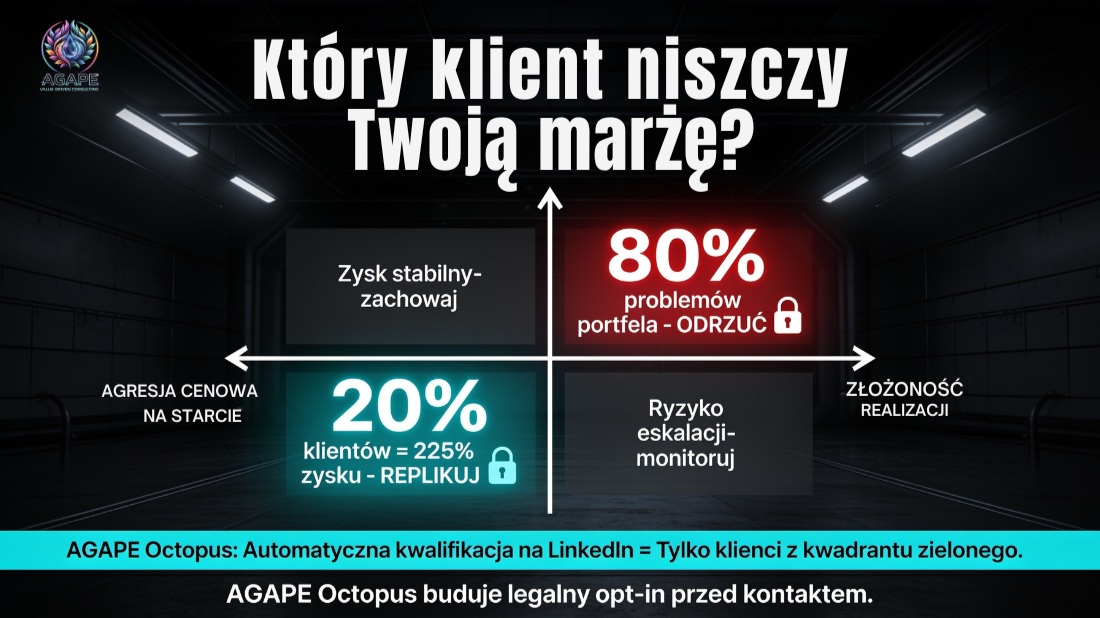
The Core Problem: Price vs. Profit
In B2B engineering and the renewable energy sector (RES), a troubling pattern emerges: the client who negotiates most aggressively on price statistically generates the largest number of scope changes, complaints, and overtime hours across the entire project portfolio. When management convenes to discuss the most problematic contracts of recent years, the common denominator is almost always the same—these clients negotiated every possible concession, demanding matches to the cheapest market offers and pushing for scope expansions within the original price. After the contract is signed, these same entities generate multi-page acceptance protocols, demand extra site visits, and escalate issues to the board, consuming the entire planned margin.
Data from customer profitability analyses and Archdesk reports on margin fade in construction clearly indicate that this problem isn't due to bad luck or flawed execution. The source of the loss lies in the decision to accept such a contract, made weeks or months earlier during the qualification stage.
The Low-Price Paradox in Project Portfolios
In RES and engineering firms, this scenario repeats with alarming regularity. The client who fights for every discount during the bidding process later becomes the recipient who generates overtime, scope creep, and warranty claims that devour the planned margin. The Archdesk report confirms that margin erosion begins with overly optimistic cost estimates and underestimated risks at the bidding stage—not with errors on the construction site.
The Price Waterfall Model in Action
The price waterfall model, developed by McKinsey, demonstrates that the nominal margin from a calculation rarely matches the project's final result. The list price goes through a cascade of concessions:
- Negotiated discounts
- Free site visits
- Complimentary support with connection documentation
- No charges for scope changes
- Extended payment terms
- Author's supervision without additional remuneration
Each of these items lowers the actual "pocket price," often pushing it below the profitability threshold. Management often operates under the assumption that the standard calculated margin is being delivered. However, after accounting for all concessions, the margin can be dramatically lower or even negative. When the contract also generates scope creep and overtime, the project quickly moves from the low-margin category to being genuinely loss-making.
The Pareto Principle of Customer Profitability
Analyses from CFO Perspective confirm that in companies executing complex projects, 20% of clients generate 225% of the total profit, while the remaining 80% of the portfolio reduces the net result by 125%. This means the company is actually earning a fraction of what it could with a more selective approach to clients. Research by Whalesbook indicates that about 20% of the most problematic contracts account for the lion's share of overtime, contractual penalties, and service costs.
This same minority of clients, who generate the least margin, are also responsible for the majority of complaints and escalations. In the RES and B2B engineering segments, these problematic 20% are most often clients for whom price was the main selection criterion. This pattern of a difficult B2B client is not an exception but a predictable effect of a lack of rigorous qualification at the outset.
Customer Profitability Analysis as an Operational Tool
Customer Profitability Analysis (CPA) involves assigning not just revenue but also the full cost of service to each client: direct implementation costs, service costs, warranty claims, post-sales support, and the cost of acquisition and relationship maintenance. In an RES company, a client who orders regularly but constantly negotiates the minimum rate and generates a high number of incidents may actually be less profitable than a client who orders less frequently but accepts a healthy margin.
CPA provides objective data that helps justify uncomfortable decisions—like refusing to bid for a problematic client or denying another discount—without having to rely on intuition.
What Rigorous Client Qualification Looks Like
Lead qualification frameworks like BANT, CHAMP, and MEDDIC provide formal criteria for evaluating a lead before deciding to submit an offer. In the context of RES and engineering firms, qualification includes assessing the client's risk profile, their behavior history in previous projects, their willingness to share responsibility for scope and changes in a partnership model, and their real budget and decision-making path.
The goal of qualification is not to reject as many clients as possible but to consciously manage portfolio risk, ensuring that execution resources are allocated to contracts with a healthy, built-in margin. Implementing these frameworks can reduce the number of toxic contracts without a drop in total revenue.
Practical Consequences for the C-Suite
Decision-makers in RES and B2B engineering firms face a choice: fill the pipeline at all costs or manage the portfolio for total profitability. The data shows that limiting engagement with the least profitable clients, even if it means a temporary drop in revenue, increases net profit and frees up operational resources.
Companies that implement precise systems for reaching decision-makers instead of relying on mass cold outreach naturally limit the number of clients focused solely on the lowest price. They reach CFOs and plant directors who buy value, not an hourly rate. The initial client qualification stage, therefore, determines whether a company will execute projects with a built-in time bomb or build a portfolio that ensures a predictable, healthy margin.
This article was created with AGAPE's proprietary content machine AGAPE Liberty.
Frequently asked questions
Ready to evaluate fit?
Book a 25-minute discovery call and let's see if AGAPE is the right partner for your next campaign.
Schedule a 25-minute discovery call