The Measurement Gap in the Age of AI Discovery
"I have numbers for everything except whether AI tools mention us at all."
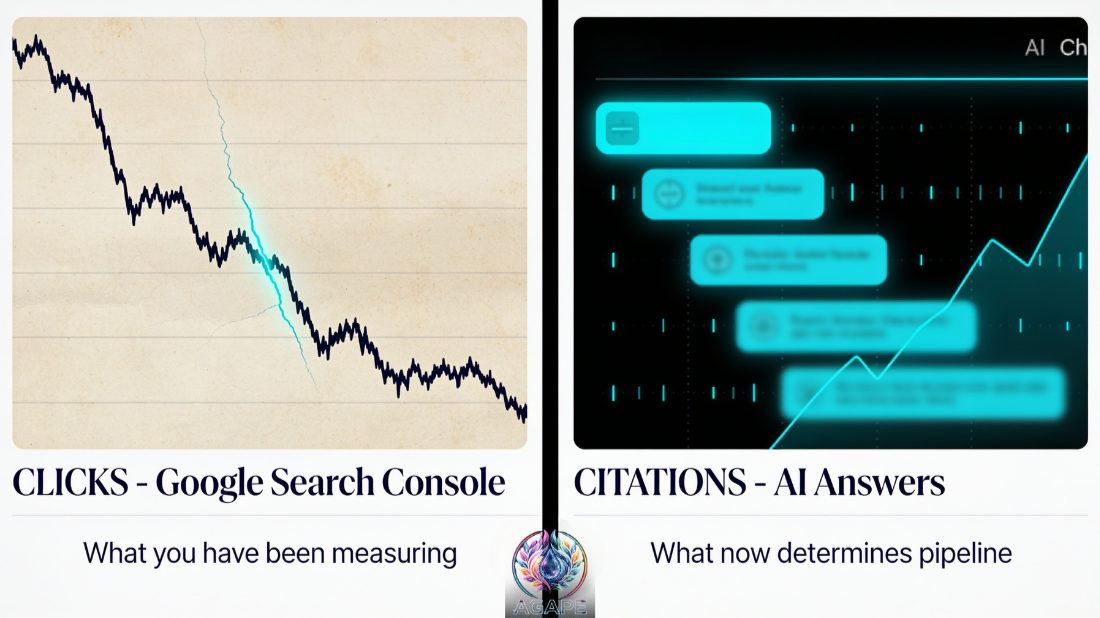
That sentence from a recent marketing report highlights a critical blind spot for many leadership teams. While we meticulously track cost per acquisition, organic sessions, and email revenue, a new channel is emerging where buyers ask their first questions: AI assistants. When the conversation turns to visibility on these platforms, many marketing leaders find themselves without a solid number, defending budgets with data from channels that buyers are increasingly bypassing.
This gap in measurement compounds quarterly. Boards observe declining traffic against flat spend and question the weakening returns. The honest answer is that the initial discovery phase has moved to a place our dashboards don't yet cover. Without a metric for AI visibility, marketers are left defending their strategies with habit rather than hard evidence. The solution is a reportable KPI, a metric AGAPE Automation Systems has named "AI citation share." This article provides the complete specification for implementing it.
What AI Overviews Mean for Your Traffic
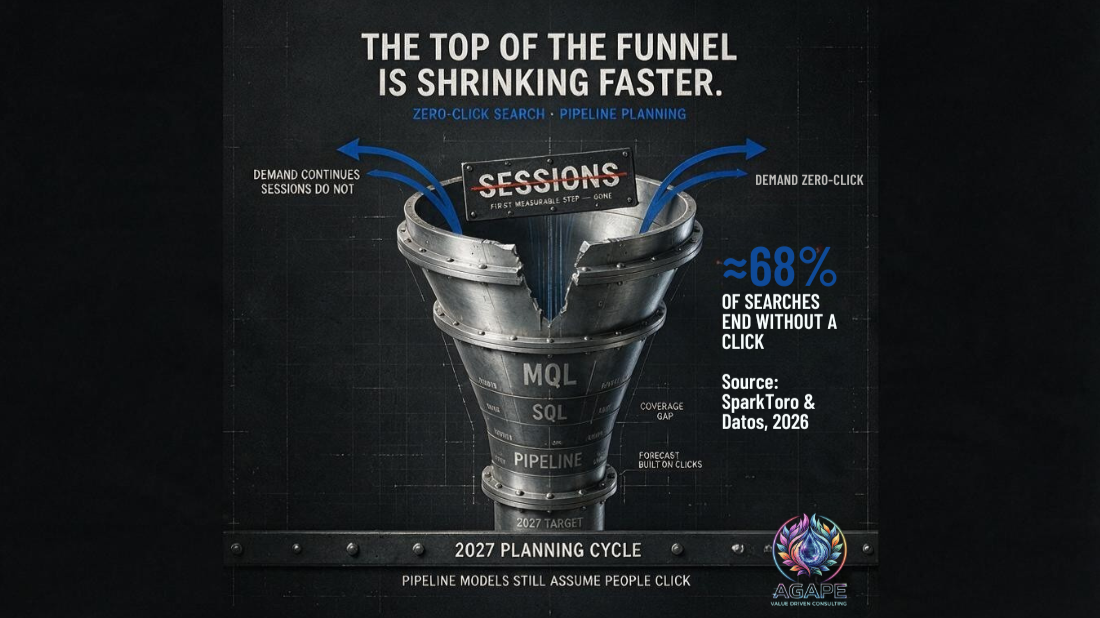
The rise of AI-generated summaries in search results is directly impacting traditional metrics. Google AI Overviews, for instance, now appear on a significant portion of queries. When they do, studies show that click-through rates for both top-ranking organic results and paid ads can plummet by 50-68%. This displacement hits the very informational queries that fill the top of a B2B funnel.
The impact extends beyond just those queries with AI summaries. Some sites have reported overall organic traffic declines of 20-40% for informational keywords since the rollout of these features. With a large percentage of searches already resulting in "zero-clicks," this new AI layer further reduces the likelihood of a user visiting your website. From a board's perspective, this isn't a data mystery—it's a data hole.
The High-Value Signal of AI Referral Traffic
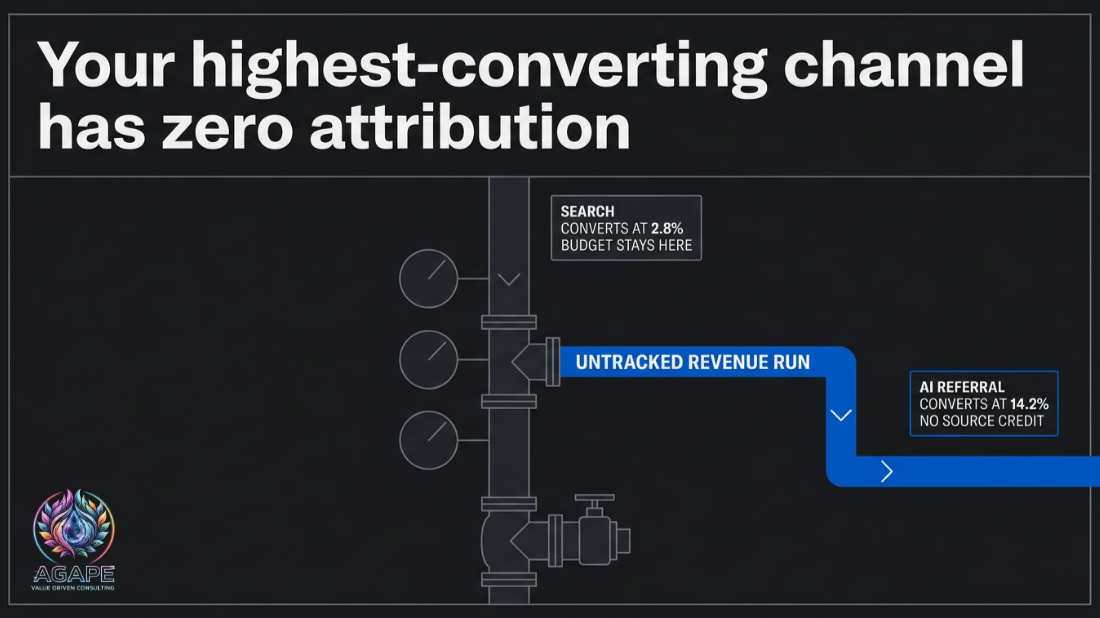
However, a powerful compensating signal is emerging. While the volume of referral traffic from AI assistants is currently small, its quality is exceptional. Data reveals that AI-referred traffic converts at significantly higher rates than any other channel. One 2026 benchmark study placed AI-referred conversion at 5.8%, outperforming paid search, email, organic, and direct traffic.
This pattern is consistent across multiple datasets. One analysis found that visitors from AI tools accounted for just 0.5% of traffic but delivered 12.1% of sign-ups—a 23x uplift. Another reported an average 4.4x conversion uplift for AI-referred visitors compared to standard organic visitors. These users have already asked an assistant for a shortlist. They arrive with high intent and decision-stage context, making them incredibly valuable. Visibility within AI answers is a leading indicator of high-quality pipeline.
Extending Share of Search Logic to AI
For years, "share of search" has been a trusted proxy for future market share. Research has shown that shifts in branded search volume reliably predict changes in market share 6-12 months later. The logic is simple, and the metric is fast, cheap, and predictive.
This same logic now applies to AI answers. When a buyer asks an AI assistant to recommend vendors, the brands it cites are gaining a competitive edge. The share of those citations you capture is a direct measure of your competitive position in this new discovery landscape. Just as share of search translated brand activity into a forward-looking number a CFO could track, AI citation share does the same for the AI layer that now sits between a buyer’s question and your website.
Defining AI Citation Share: A Board-Ready Metric
Here is a 50-word definition you can use directly in your reporting:
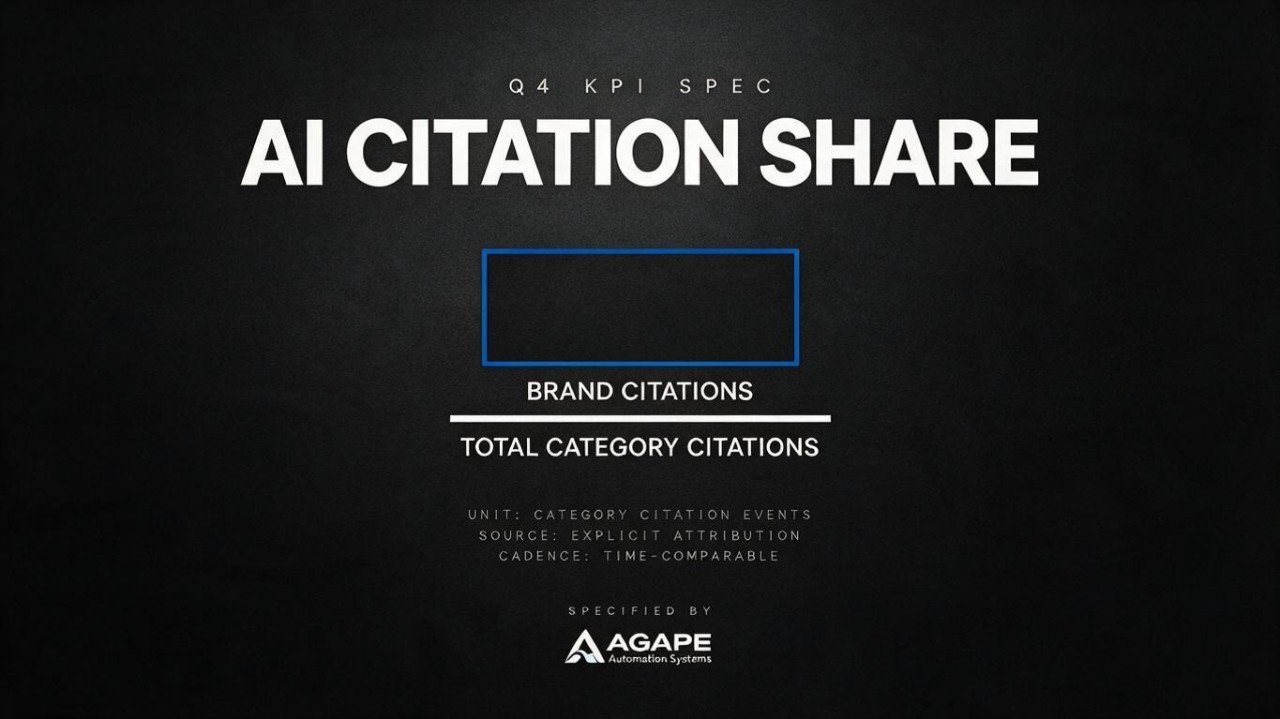
"AI citation share is the percentage of total citation events a brand captures within a fixed set of buyer-intent prompts run across multiple AI engines, counting only explicit source attributions, compared period over period on the same prompts and engines, and tied to pipeline through recorded discovery sources in CRM."
How to Measure It
What to Count: The metric exclusively tracks explicit source attributions—that is, when an AI response includes a clickable link to your domain in its sources, citations, or references. A simple mention of your brand name without a link does not count, as only linked citations drive referral traffic and signal authority to the models.
Building the Prompt Set: Anchor your measurement in a fixed set of 30-50 buyer-intent questions. These should mirror the real-world language your customers use, sourced from customer interviews, search analytics, and sales team insights (e.g., "who are the leading vendors for industrial automation systems?"). This prompt set must remain constant between measurement periods to ensure comparability.
The Formula: The calculation is straightforward: AI citation share = (Citation events for your brand / Total citation events for all brands) x 100
Track the absolute and relative change period-over-period to show the board whether your competitive position is improving.
Implementing and Reporting AI Citation Share
To make this metric actionable, it must be linked to business outcomes. Add a field to your CRM or lead capture forms like "Discovered via AI assistant." This allows you to correlate a rising AI citation share with an increase in high-intent leads, demonstrating a clear return on investment.
A Dated Example from AGAPE's Own Tracking
At AGAPE Automation Systems, we practice what we preach. We run this measurement monthly. In a four-week period ending September 18, 2026, AGAPE's citation share was 14.3% across 42 locked prompts on three engines. This was a significant increase from 9.1% in the prior period—a 57% relative change. During that same time, we saw a corresponding rise in CRM entries tagged "Discovered via AI assistant," giving our board two data points connecting AI visibility to pipeline growth.
Establishing a Rhythm
The methodology works because it is disciplined and repeatable. It requires no complex tooling, only consistent execution.
- Monthly: Run the full prompt set across your chosen engines (e.g., a general assistant, an AI search engine, Google AI Overviews) and calculate your share.
- Quarterly: Aggregate the monthly data, calculate the change, and include a single, clear slide in your board report.
- Annually: Review and update your prompt set, documenting any changes to maintain comparability.
By adopting this structured approach, you can close the visibility gap in your marketing reports. You can enter your next board review with a complete story, reporting on AI visibility with the same rigor as every other channel. The question is no longer whether you can measure your presence in AI, but what number you will report. What's your plan?
This article was created with AGAPE's proprietary content machine AGAPE Liberty.
Frequently asked questions
Ready to evaluate fit?
Book a 25-minute discovery call and let's see if AGAPE is the right partner for your next campaign.
Schedule a 25-minute discovery call