Imagine an AI agent sending a sequence to 40,000 decision-makers in the manufacturing industry. The model cites a case study with a company that was never a client, attributes an integration to the product with a system the provider doesn't offer, and the whole thing sounds so professional that the recipient's only reaction is to click 'reply.' This scenario is not theoretical. Even top models achieve significantly less than 100% accuracy on tasks requiring precise knowledge, as shown by the FACTS framework developed by DeepMind and analyzed by galileo.ai. At a scale of tens of thousands of monthly sends, typical for tools like Cirrus Insight, Regie.ai, or Apollo.io, a single factual or stylistic error can be replicated thousands of times before being detected.
Decision-makers in SMBs understand this math perfectly. Manual sales processes don't scale, but any automated system with direct access to a corporate domain and client inboxes carries a risk that cannot be undone after sending. COOs and CTOs see not only a drop in the sender's reputation but also the real consequences of GDPR violations and the extra IT team hours needed to salvage the situation.
When AI Writes to Clients Unchecked
The risk of hallucination isn't limited to numbers and facts. Language models also generate culturally or industry-inappropriate phrasing when the prompt doesn't precisely define the tone and scope of topics to avoid. In practice, this means a message might contain a joke in correspondence with a bank or an overly direct phrase in the medical sector. Such an error, sent en masse, becomes material for LinkedIn and industry forums, and the brand appears in the context of 'another company that trusted AI without control.'
A broader problem is the phenomenon described by firstlinesoftware.com as 'AI-generated brand reality.' AI systems not only describe the company but actively co-create its image in search results, chatbot responses, and automatically generated content. When current, structured data is lacking, the model fills the gaps with analogies to other entities in the industry. As a result, a prospect receives a message where our company allegedly collaborates with an entity it has never contacted or offers a feature that exists only in the model's statistical interpolation. This risk grows with the scale of sends and cannot be eliminated by simple prompt adjustments.
Why Standard Outbound Tools Fall Short
Most available solutions, including Cirrus Insight, Regie.ai, Apollo.io, or Smartlead, focus on productivity and personalization, as confirmed by analyses from hunter.io/blog and cirrusinsight.com. These tools claim the ability to write 'like a human,' but their architecture offers no hard guarantees against hallucinations or pre-send content validation mechanisms. The decision to send, domain selection, and opt-out logic remain in a probabilistic layer or are handled by integrations that don't separate risk from the client's main mail infrastructure. For SMBs, this means that implementing another productivity tool doesn't solve the fundamental problem of control.
An additional burden is the need to involve the IT team. Configuring CRM integrations, modifying mail servers, managing API keys, and monitoring logs consume weeks of man-hours diverted from business-critical projects. When a solution requires access to internal servers, any configuration error or API abuse can infect the entire email infrastructure, not just the sales campaign.
Zero-Hallucination Architecture: Separation of Roles as a Foundation for Security
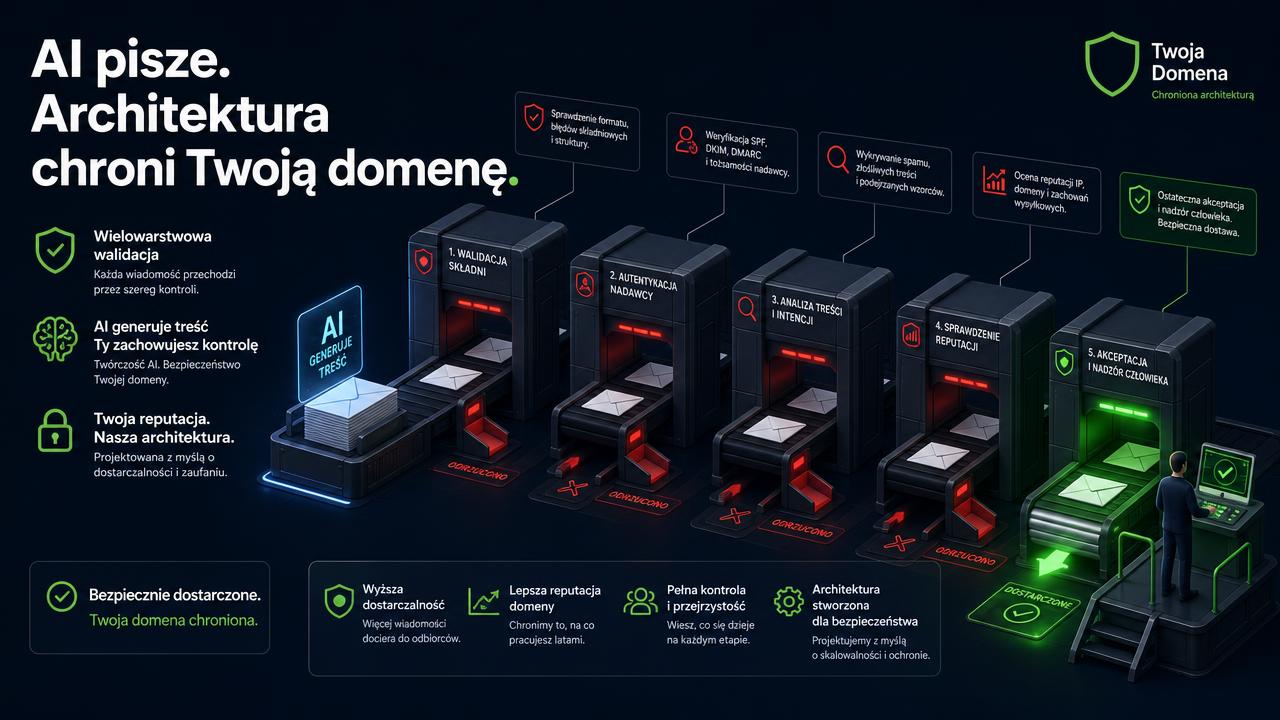
Zero-Hallucination Architecture is based on an inviolable boundary between the conversational domain and the execution layer. The language model plays a purely conversational role, while all business logic, sending decisions, domain selection, and privacy policy compliance verification remain in the deterministic layer. The deterministic layer operates with the precision of a compiled program: it checks conditions, executes actions, calls APIs, and validates compliance rules without any probabilistic element.
In practice, this means that the AI can propose a version of the message content, but the decision to send, domain selection, daily limits, and opt-out logic are handled by an engine where no hallucination has a direct impact on the system's actual actions. Retrieval-augmented generation (RAG) powered exclusively by trusted data further strengthens this separation, as the model operates only on verified information, not statistical interpolation. Human-in-the-loop mechanisms and pre-send validation close the final gap, eliminating both factual errors and unprofessional phrasing.
Implementation Without Touching Internal Infrastructure
The solution operates on an external, isolated infrastructure with dedicated secondary domains and IP clusters. This separation protects the main corporate domain from the risk of blacklisting. When mass mailings from the company domain lower SPF, DKIM, and DMARC scores, transactional emails, invoices, and client communication start landing in the spam folder. Dedicated domains and isolated IP clusters eliminate this mechanism at the source, as the entire sending layer is managed by the provider and does not require modification of the client's internal mail servers or the involvement of their developers.
For SMBs, this means the implementation doesn't generate additional IT team man-hours. The system does not interfere with the existing infrastructure, and the risk of 'burning' the corporate domain is structurally separated from the company's daily communication.
GDPR Compliance as an Architectural Element, Not an Add-on
The EDPB's opinion from December 2024 confirms that legitimate interest can be a valid legal basis for training and deploying AI models, provided that appropriate technical and organizational safeguards are applied. This opinion removes uncertainty about the legal possibility of relying on legitimate interest but also raises the bar for documentation.
The EDPB's three-part test requires demonstrating that the interest is lawful, clearly defined, and real; that the purpose could not be achieved with less data or with synthetic data; and that the rights of individuals do not override the controller's benefits, considering the risks of bias and discrimination. Specific technical measures indicated by the EDPB include respecting robots.txt and ai.txt files, pseudonymization, masking, and filtering personal data during training, and limiting the models' ability to store, reproduce, and generate personal data during deployment. Mechanisms for exercising individuals' rights, including objection, access, and erasure, must be built into the process, not added as a separate layer.
Zero-Hallucination Architecture integrates these requirements from the start: personal data is filtered before reaching prompts, output content is validated for sensitive information disclosure, and all compliance logic remains in the deterministic layer.
Implementing such an architecture transforms sales automation from an experiment fraught with brand risk into a controlled, repeatable process. Decision-makers receive a guarantee that AI-generated content is always based on verified sources and passes through deterministic compliance rules, while the language model is limited to formulating proposals in the conversational layer.
This article was created with AGAPE's proprietary content machine AGAPE Liberty.
Frequently asked questions
Ready to evaluate fit?
Book a 25-minute discovery call and let's see if AGAPE is the right partner for your next campaign.
Schedule a 25-minute discovery call