The Moment of Truth: From Abstract Percentage to Cash Outflow
Imagine the scene: your company has just secured a landmark PLN 2 million contract. The team is celebrating, and the future looks bright. Then, an invoice from your intermediary partner lands on your desk: PLN 100,000, representing a 5% 'success fee'. Suddenly, an abstract percentage becomes a concrete cash outflow. This is the moment when every CEO and COO in the Industry 4.0 space must confront the real cost of client acquisition. The pressure to replace a lost client or hit aggressive growth targets often leads to agreements that seem attractive on the surface but can cripple profitability when the bill comes due.
This single figure must now be measured not against the headline revenue, but against the contract's actual contribution to gross profit, operating income (EBIT), and free cash flow. Let's dissect the arithmetic that often gets overlooked in the rush to close a deal.
The Deceptive Allure of Percentage-Based Fees
Why do success-fee arrangements feel so seductive? The answer lies in the high cost and long timeline of building an in-house sales team. Filling a specialized field sales role can take 45 to 60 days. Once hired, a new account executive needs an average of 5.7 months to reach full productivity. The company only begins to see a return on this investment around the 11-month mark, having paid a full salary and overheads throughout the ramp-up period. As many leaders lament, "It takes four months before a salesperson starts paying for themselves, yet I pay the full salary from day one."
Faced with this reality, an external partner promising qualified meetings and closed deals with no upfront cost seems like a perfect solution. You only pay for results. However, the invoice that arrives after the PLN 2 million contract is signed reveals the hidden math that was never run when the handshake agreement was made.
A Practical Example: Deconstructing a PLN 2 Million Contract
To understand the true impact, let's follow the PLN 100,000 fee as it cascades through the contract's financial structure. The top-line revenue of PLN 2,000,000 is just the starting point.
Impact on Gross Margin
Gross margin is the first critical line item. The profitability of your projects dictates how severely this fee will be felt.
- At a 30% gross margin: The contract generates PLN 600,000 in gross profit. The PLN 100,000 fee consumes 16.7% of that profit.
- At a 20% gross margin: The contract yields PLN 400,000 in gross profit. The fee now consumes a full 25% of it.
- At a 15% gross margin: The gross profit drops to PLN 300,000, and the fee takes a staggering one-third of the profit generated before any other operating expenses are even considered.
Impact on Operating and Net Profit
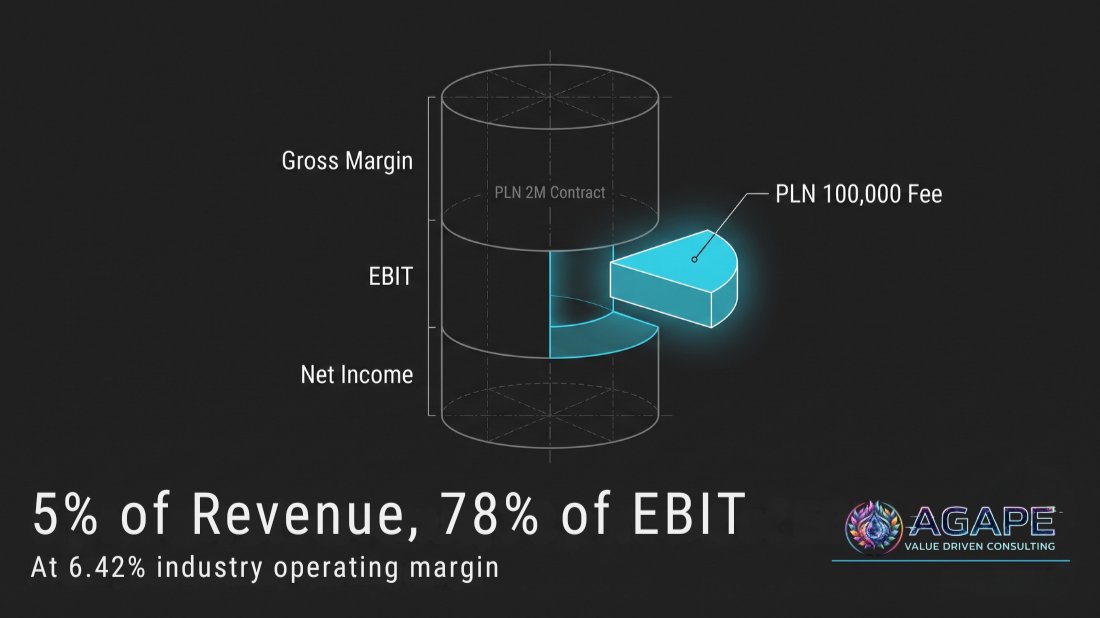
Operating margin (EBIT) provides an even starker picture. According to CSIMarket data for 2026, industrial machinery and components companies report an average operating margin of 6.42%. On a PLN 2 million contract, this translates to an expected EBIT contribution of approximately PLN 128,400. The PLN 100,000 success fee absorbs nearly 78% of the entire expected operating profit.
The story worsens as we move down the P&L. The same sector's net margin averages 5.62%, meaning the contract should generate PLN 112,400 in net income. The fee erodes almost 89% of it. And what about cash? With an average free-cash-flow margin of 6.5%, the contract should generate PLN 130,000. After the intermediary is paid, only PLN 30,000 remains.
Why Does 5% 'Feel' Cheap? The Market Context and The Trap
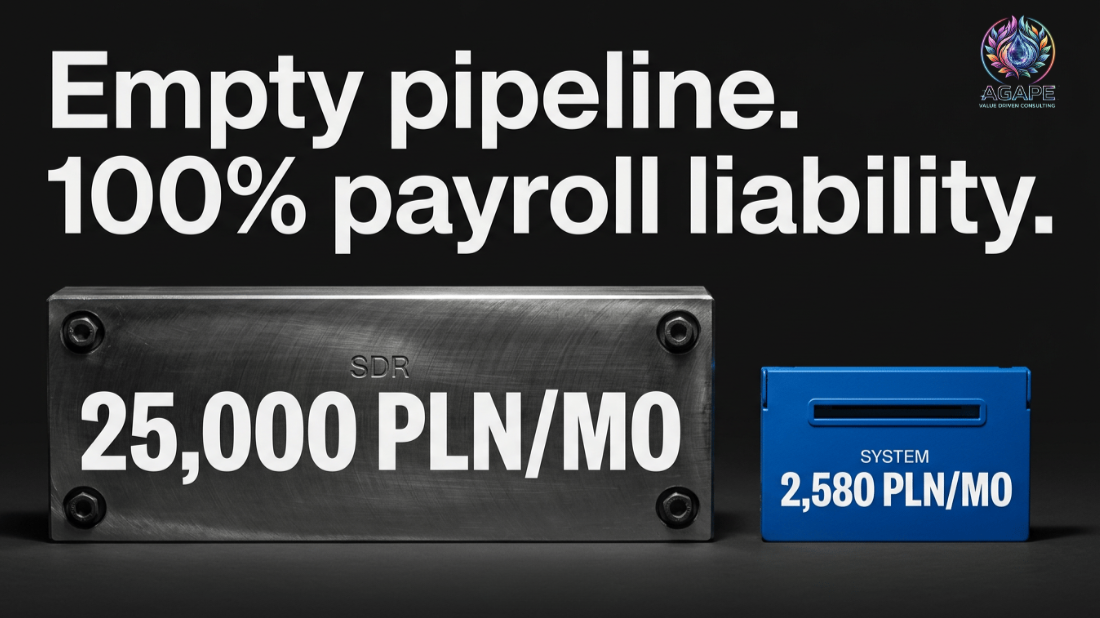
A 5% fee sits at the low end of typical B2B sales commission rates, which range from 5% to 20%. Independent manufacturers' representatives often earn 8% to 16%. This makes 5% appear to be a bargain. The trap, however, is that this "cheap" percentage becomes prohibitively expensive on large contracts. A single PLN 100,000 payment can easily exceed the entire annual cost of a fixed-subscription client acquisition system.
Even lead-generation agencies, whose business is client acquisition, often find pure commission-only models unsustainable. Many insist on hybrid structures—a monthly retainer plus a smaller commission of 5-15%—proving that the party accepting pure percentage terms is the one shouldering all the risk and downside.
The Hidden Penalty: Eroded Margins and Enterprise Value
The damage isn't confined to a single contract's P&L. In today's market, manufacturing companies with advanced Industry 4.0 capabilities command a significant valuation premium, with EBITDA multiples of 6.2x compared to 3-4x for traditional operations. Since enterprise value is directly driven by EBITDA, every zloty of margin eroded by high acquisition costs carries an outsized valuation penalty. The decision to accept a 5% success fee is not just an operating expense—it's a direct lever that compresses your company's long-term value.
A Smarter Alternative: The Predictability of Fixed-Cost Models
How do fixed-cost alternatives compare? That PLN 100,000 fee (roughly $25,000 USD) is equivalent to over three months of an $8,000/month lead-generation retainer. While agency retainers can range from $2,000 to $25,000 per month, a fixed annual cost turns an unpredictable variable expense into a planned investment.
An annual retainer of $96,000 that generates PLN 6 million in revenue results in an effective acquisition cost of 6.4%—but this percentage decreases with every additional contract won. This model provides predictability and scales efficiently. Outsourced sales development models often report 30-50% cost reductions compared to in-house teams by consolidating recruitment, salaries, and infrastructure into a single, manageable monthly expense.
Your Two-Second Decision Rule
Before you sign any percentage-based agreement, apply this simple test:
- Calculate the fee in absolute terms (e.g., PLN 100,000).
- Divide the fee rate by your gross margin rate (5% / 20% = 25%). This is the share of gross profit consumed.
- Divide the fee rate by your operating margin rate (5% / 6.42% = 78%). This is the share of EBIT consumed.
This quick calculation transforms a seemingly small percentage into a clear indicator of its true impact on your bottom line. When a fee consumes more than half of your expected EBIT, it's time to reconsider the deal.
This article was created with AGAPE's proprietary content machine AGAPE Liberty.
Frequently asked questions
Ready to evaluate fit?
Book a 25-minute discovery call and let's see if AGAPE is the right partner for your next campaign.
Schedule a 25-minute discovery call