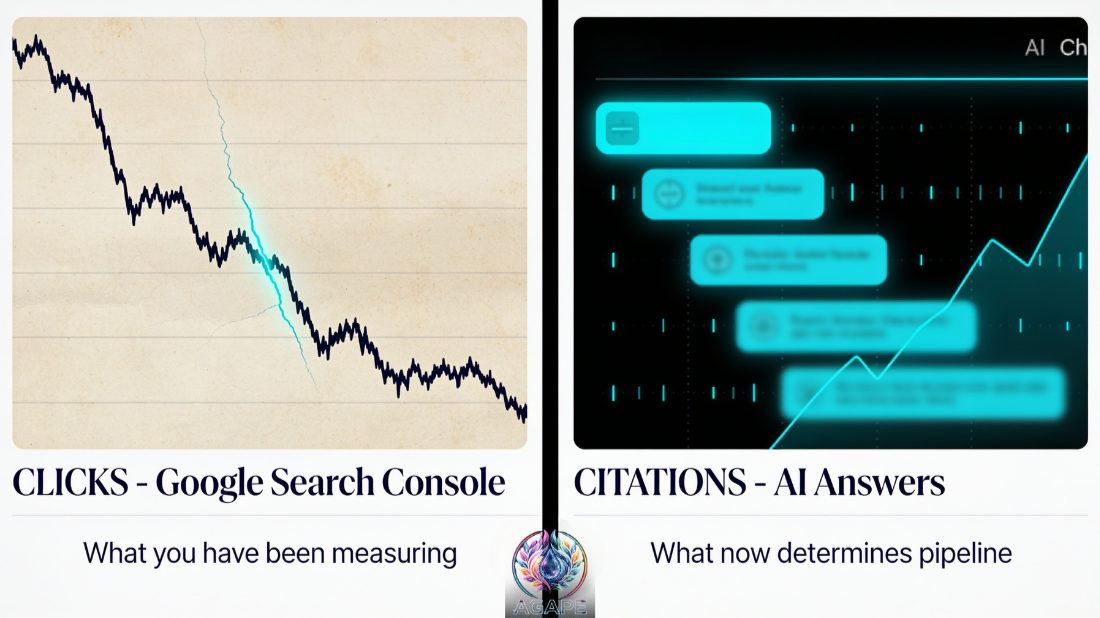
Imagine a B2B sales team that observes a drop in organic SEO traffic but sees more and more inquiries and submissions initiated by AI responses and conversational searches. The budget isn't growing, so the question is: where to shift the focus of activities to return to stable growth?
The centers of gravity for leads in 2027 are shifting to three axes: generative responses and AI agents, fast-growing formats like retail media, and first-party data and video integrated into a funnel based on AEO/GEO and outbound activities. In the background, the entire European digital market is growing (131 billion euros with 10.5% dynamics), and retail media is adding acceleration and new inventory (13.3 billion euros at 16.7%)—this is a clear map of where budgets and demand are really flowing.
Below, you get specific moves: how to gain visibility in AI Overviews and agent results (AEO/GEO), how to build a pipeline ready for agents, how to set up attribution for results, and what benchmarks and costs are achievable with examples from AGAPE implementations—along with a framework for launching in 14–28 days.
Key Takeaways for 2027
- Leads are shifting to generative responses and agents—visibility in AEO/GEO is becoming critical for the top of the funnel.
- Budgets are accelerating in retail media, opening up new inventory and 1st-party data synergies.
- Europe is growing in digital—this confirms that performance and results-based attribution are becoming the standard.
- B2B Benchmarks: 71% qualified leads to customer and 12 meetings per month are possible with automated outbound.
- C-level on LinkedIn accepts invitations 35–40% of the time—but only with a precise persona and cadence.
Where to Find Leads in 2027: Mapping Channels That Actually Deliver
The most reliable sources of B2B leads in 2027 are the space of AI responses (AEO/GEO), agents, retail media, LinkedIn, and automated outbound—all integrated into a single, semantically and measurement-consistent funnel.
-
AI answer engines and Overviews
- Take shortcuts: design content in unambiguous paragraphs with a clear thesis and specifics, add checklists and "step-by-step" instructions, use your own numbers and benchmarks to increase the chance of being cited.
- Organize entities (brand, offer, ICP, use cases, pricing), implement AEO/GEO structure and dedicated files/manifests for models to facilitate data retrieval by generative engines. You can find more details in the analysis on brand invisibility in AI—see the material on visibility in AI and the risk of non-exposure.
-
AI agents and "agent-based commerce"
- Prepare offers in the form of short benefit cards with clear terms, pricing policy, and path to purchase, so that agents can recommend and finalize them.
- Provide interfaces and structures that make it easier for agents to choose (e.g., differentiating criteria and variants), and describe content with entities to get on shortlists.
-
B2B retail media
- Take advantage of growing inventory and buyer data: the segment has reached 13.3 billion euros, growing by 16.7%, which signals an intensification of budgets and the availability of specialized placements for vertical segments.
- Combine campaigns with 1st-party data and remarketing based on signals from AEO content to close the demand loop.
-
LinkedIn and B2B social
- Target decision-makers with a precise persona and value hypotheses—C-level acceptance rates of 35–40% are achievable with a well-matched cadence. Tips on benchmarks are collected in the material on C-level acceptance rates on LinkedIn.
-
Automated outbound
- Steadily delivers 12+ meetings per month if you orchestrate it multi-channel (LinkedIn + email + AEO landing pages) and continuously validate personas and messages. You can read about filter resistance and deliverability in the guide on deliverability as a competitive advantage.
How AI is Changing Demand Generation: From SEO to GEO/AEO and Conversations
We are moving from a strategy focused on classic rankings to being cited by models and chosen by agents. This requires restructuring information on the website and the way content is written.
-
Define entities and grounding
- Precisely describe entities: brand name, offer lines, price ranges, ICP, use cases, KPIs, and results. Implement structured data and a glossary on your site so that models can flawlessly map your offer.
-
Design "quotable" paragraphs
- Write short, categorical answers (one thesis + proof, preferably numerical), supplemented with specific steps. This increases the chance of being featured in AI Overviews and conversational model summaries.
-
Combine SEO with GEO
- Create Q&As for natural conversational queries and short "how-tos" with a clear result; pay attention to headings and paragraph segmentation for generative logic, not just keywords. The structural differences and recommendations are described in the compendium on AEO vs. SEO and the impact on AI recommendations.
-
Play for answer slots in a growing market
- Competition for "answer slots" will become increasingly fierce, as the European digital market has grown to 131 billion euros with 10.5% dynamics. This signals pressure for quality, specifics, and proof.
Content and Site Design for AI Overviews and Agents: The AEO Pattern in Practice
For models to quote you and agents to choose you, content and information must be organized like a product, not an essay.
-
Layer of proof and numbers
- Publish your own metrics and case studies. For example, a 71% conversion from MQL to customer is strong, citable proof of effectiveness—such snippets get into summaries and build trust.
-
Manifests and action paths for agents
- Add files and sections dedicated to LLMs (e.g., manifests with entities, scope of services, prices, policies), as well as clear "calls to action" and offer variants, so agents can perform actions without guesswork. A practical manifest template can be found in the guide on files for AI shortlists.
-
Entity paragraphs and offer
- Create entity cards for: brand, key products, pricing variants (e.g., plan from €260 net/month), and feature limits. These minimal information blocks are most often retrieved for model responses.
-
Semantic context and navigation
- Use a consistent cadence of internal links between AEO/GEO sections and auxiliary files. This strengthens entity coherence and facilitates grounding. More on the risks of non-exposure is described in the analysis on brand invisibility in AI.
First-Party Data, Attribution, and KPIs: How to Measure Lead Acquisition Effectiveness in 2027
The most important changes in measurement are the shift from vanity metrics to outcomes and the integration of 1st-party data with channels that are accelerating.
-
Outcomes over clicks
- Prioritize outcome-based KPIs (booked meetings, SQLs, pipeline, ARR), because the digital market in Europe is growing and rewards payment for results, not for reach.
-
1st-party data × retail media
- Combine your own audience data with insights from retail media, which is growing faster than digital overall. This drives segmentation and lookalikes for ABM and allows for building precise cadences.
-
Cost of signal and time-to-signal
- Define the cost of reaching the first reliable signal of ICP fit. A one-time analytical report for €49 allows for a quick diagnosis of segment potential and prioritization of actions.
-
Cheap hypothesis validation
- Maintain a continuous loop of persona and message validation in a unit cost model—persona validation at €1 per record allows for testing without the risk of "burning out" domains and budget.
Video and B2B Influencers: When They Work and How to Integrate Them with an AI-Based Funnel
Video and creators work best when they deliver signals for agents and models and close ABM/outbound—not when they compete for raw reach.
-
Problem → solution formats
- Build short materials that clearly solve a specific ICP pain point and lead to an AEO-optimized offer card with a clear CTA.
-
Expert-practitioners and entities
- Choose creators with real "proof of work" in a given segment, and construct material descriptions with entities (product, use case, result) to get into AI responses.
-
Distribution and budget
- Repurpose materials for retail media and YouTube and feed them into 1st-party remarketing. The growth of the retail media category justifies maintaining a budget allocation for it.
-
Integration with outbound
- Include video in specific cadences: LinkedIn contact + short clip + AEO card. Use C-level acceptance benchmarks of 35–40% to estimate top-of-funnel volume and close the funnel.
How Much Does It Cost and How to Build a Business Case: Example Paths and Benchmarks
The budget for an AEO + agents + outbound funnel is calculable, and the effects can be verified in a short time—especially in a "pilot + scale" model.
-
Minimal outbound engine start
- The Liberty plan starts at €260 net per month—a reasonable entry point for a PoC and hypothesis testing.
-
A fuller funnel with lead magnets
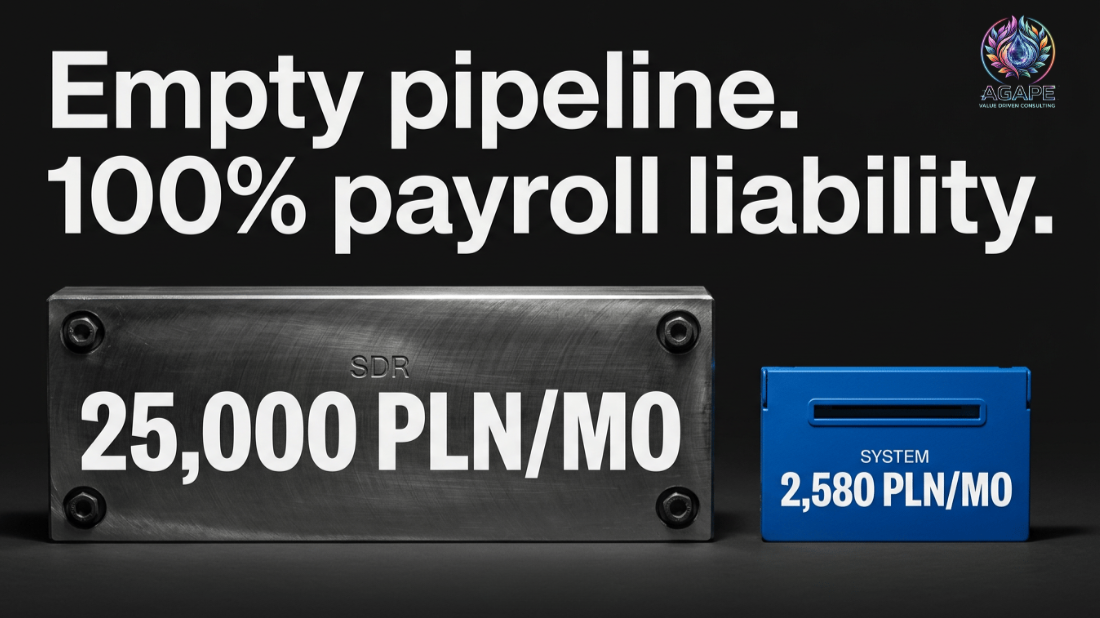
- The Octopus plan starts at €550 net per month, which allows you to compare the TCO with the alternative of an internal SDR and additional tools.
-
Validation and research
- Persona validation costs €1 per record, and a one-time analytical report is €49—such unit costs make it easier to make decisions about scale without long cycles.
-
Expected results
- With proper channel orchestration, you can deliver 12+ meetings per month and maintain a 71% conversion from MQL to customer with well-chosen ICPs and cadences.
-
Where to check details
- Details of offers, KPIs, and scopes can be found on the AGAPE main page—see offers and KPIs.
90-Day Implementation Plan: From Audit to the First 12 Meetings
Divide the implementation into four phases: audit and hypotheses, AEO/GEO foundations and offers for agents, start of machine-run outbound, and then optimization and stabilization of signals.
-
Phase 1: Audit, ICP, and quick signals
- Conduct an entity and content audit, define the ICP, and launch cheap persona validation at €1 per record. Add a one-time analytical report for €49 to confirm segment and message priorities.
-
Phase 2: AEO/GEO foundation and readiness for agents
- Publish Q&As and short "how-tos" as well as entity paragraphs (brand, product, pricing, limits). Add manifests/guidelines for models and clear "order/compare" paths. Configure LinkedIn/Email cadences.
-
Phase 3: Start of automated outbound
- Launch a multi-channel sequence. In target segments, aim for C-level acceptance rates of 35–40% thanks to a precise persona and messages based on 1st-party signals.
-
Phase 4: Optimization and scaling
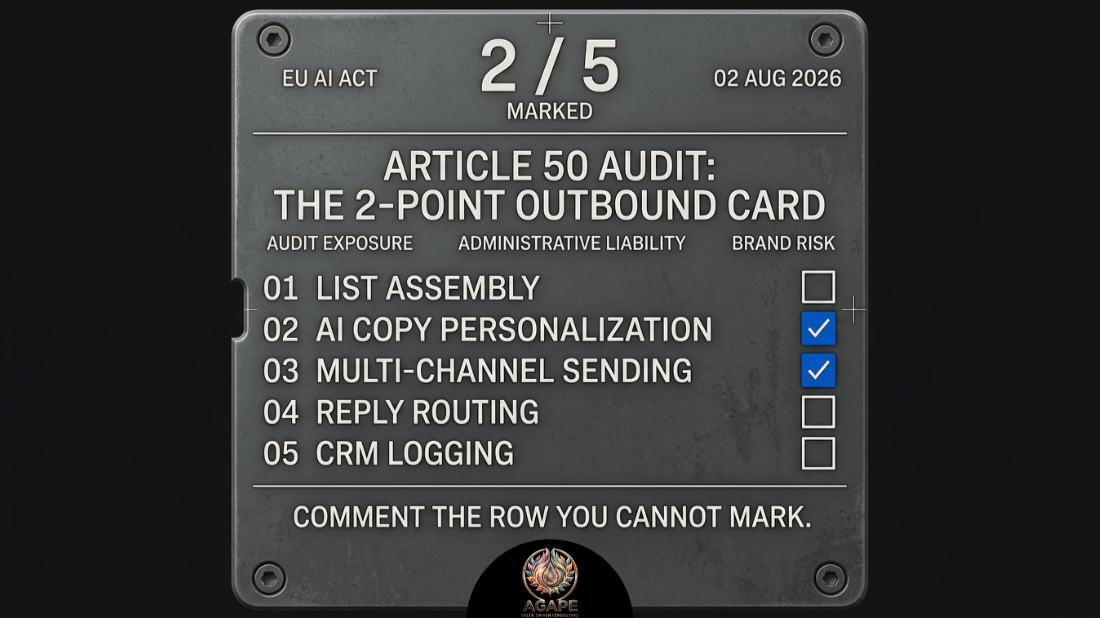
- Strengthen cadences based on first-party data and retail media slots. Maintain the goal of 12 meetings per month and a predictable time-to-signal. As a framework, expect to go live in 14–28 days if content and infrastructure are ready. In the background, ensure process compliance with regulatory requirements—the guidelines described in the material on regulatory implications for outbound automation will be helpful.
This article was created with AGAPE's proprietary content machine AGAPE Liberty.
Frequently asked questions
Ready to evaluate fit?
Book a 25-minute discovery call and let's see if AGAPE is the right partner for your next campaign.
Schedule a 25-minute discovery call